Candyman Wrings Terror Out of the Horror of Gentrification
At a time of widespread urban gentrification, Candyman suggests that the ghosts of the displaced won’t disappear so easily.
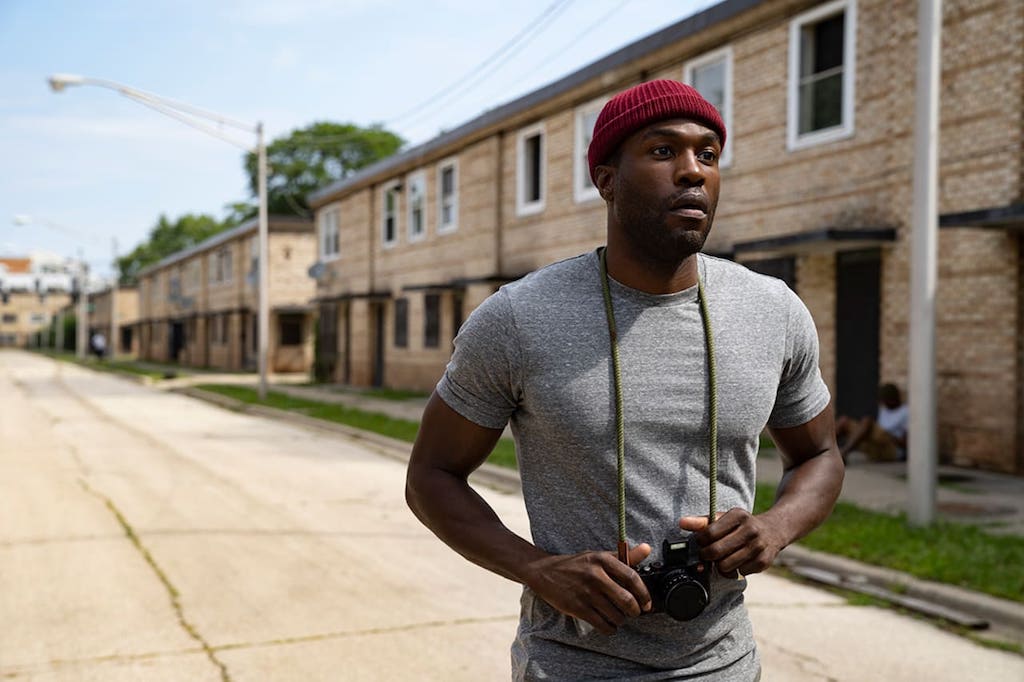
Artist Anthony McCoy (Yahya Abdul-Mateen II), the protagonist of the new Candyman, lives in a pricey high-rise on the site of the public-housing block where he grew up. (Universal Pictures)
The Cabrini-Green Homes, a complex of public-housing units on Chicago’s Near North Side, has often played an outsized role in America’s fear of public housing and all it represents. To some in the mainstream commentariat, it’s the failure of well-intentioned but badly executed liberal attempts to provide the poor with affordable places to live; to others, it’s the savagery of a black underclass they associate with unchecked crime, drugs, and gang activity.
By the late 1980s, Cabrini-Green was already synonymous in many Americans’ minds with the “urban jungle.” Into this milieu stepped the British filmmaker Bernard Rose, who was working on an adaptation of horror author Clive Barker’s short story “The Forbidden,” in which a graduate student researching the folkways of a British council estate stumbles upon a series of murders bearing the hallmarks of an urban legend. Rose decided, based on having read of the murder of Ruthie Mae McCoy and the botched police handling of it, to move the story from Liverpool to Chicago — and to the Cabrini-Green Homes, where a number of its most notorious scenes were filmed.
The movie had a distinctly British tone; although chilling and well-crafted, it scanned like the work of someone to whom Cabrini-Green was something exotic, even alien. But it also proved to be quite popular, generating several sequels. Now, in the midst of something of a golden age of black horror films, comes a new Candyman, directed by Nia DaCosta, who wrote the script along with Jordan Peele and Win Rosenfeld, Peele’s partner in Monkeypaw Productions. The new Candyman is a direct sequel to the first, set thirty years later in a Chicago where the Cabrini-Green Homes no longer exist, but the shadow they cast remains across the entirety of the city.