The Colombian Government’s War on Protesters
After six weeks of massive protests against neoliberalism and state violence in Colombia, right-wing president Iván Duque is relying on brute force to stay in power.
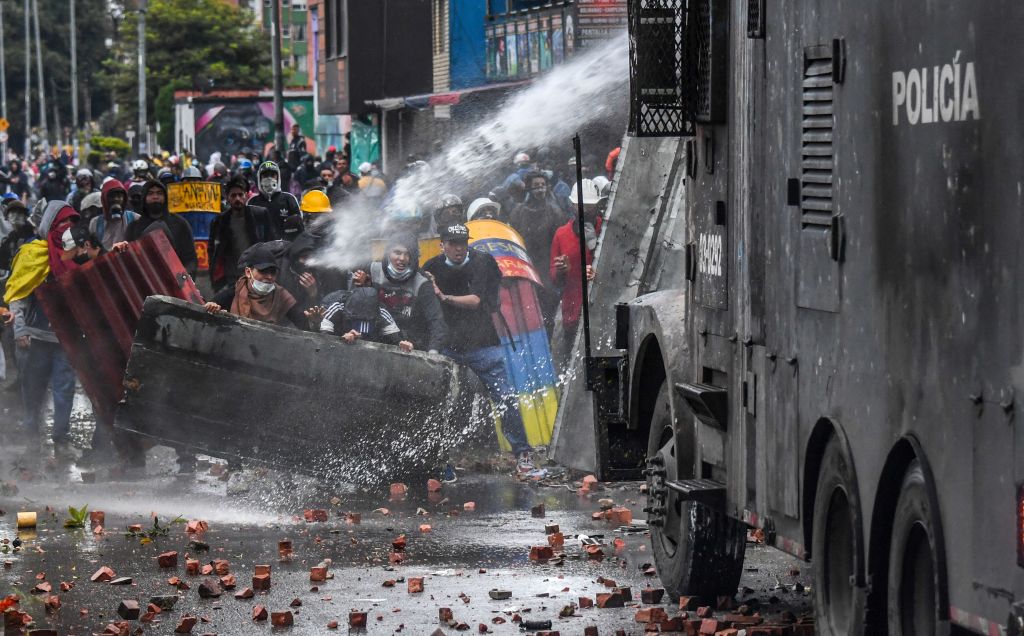
Police confront demonstrators during a protest against the government of Colombian president Iván Duque in Bogotá on June 9, 2021. (Juan Barreto / AFP via Getty Images)
Six weeks into Colombia’s general strike, protesters have won significant victories while bearing the brunt of a brutal crackdown by state and paramilitary forces. Five members of President Iván Duque’s cabinet have stepped down or been replaced. Duque withdrew his regressive tax bill that sparked the protests as well as a controversial health bill and the proposal to pay billions for Lockheed Martin war jets in the midst of the worst health and economic crises Colombia has faced in decades. A movement has consolidated with a clear focus on the government’s sabotaging of the peace accords with the Revolutionary Armed Forces of Colombia (FARC) and continued overseeing of massive inequality, which has become intolerable for large segments of the population.
Duque and his political party have shown their inability or unwillingness to respond to the protesters’ demands, which reflect Colombia’s corruption and neo-feudal inequities that have been exacerbated by the pandemic. A third wave of the coronavirus claimed over fifteen thousand lives in May and kept ICUs at near 100 percent capacity in Colombia’s major cities. Security forces have catalyzed enormous shows of solidarity with the general strike through their vicious attacks on peaceful protesters.
More than forty demonstrators have been summarily executed by state and parastate armed forces, with Human Rights Watch receiving sixty-three credible reports of deaths during the protests, two of which were police. Human rights groups Temblores and Indepaz have reported more than 2,000 documented cases of police brutality, more than 1,600 arbitrary detentions, 25 confirmed sexual assaults, 65 eye injuries, and 346 forced disappearances of protesters since the general strike began, with Indigenous, Afro, and poor communities the primary targets of repression.