The End of Public Schools Would Mean the End of the Common Good
If education is nothing but a provider of the “human capital” that will help students get a job, the argument to privatize public education will be far too convincing. Instead, we should look at our schools as institutions to educate kids to be citizens in a democracy with expectations for better lives.
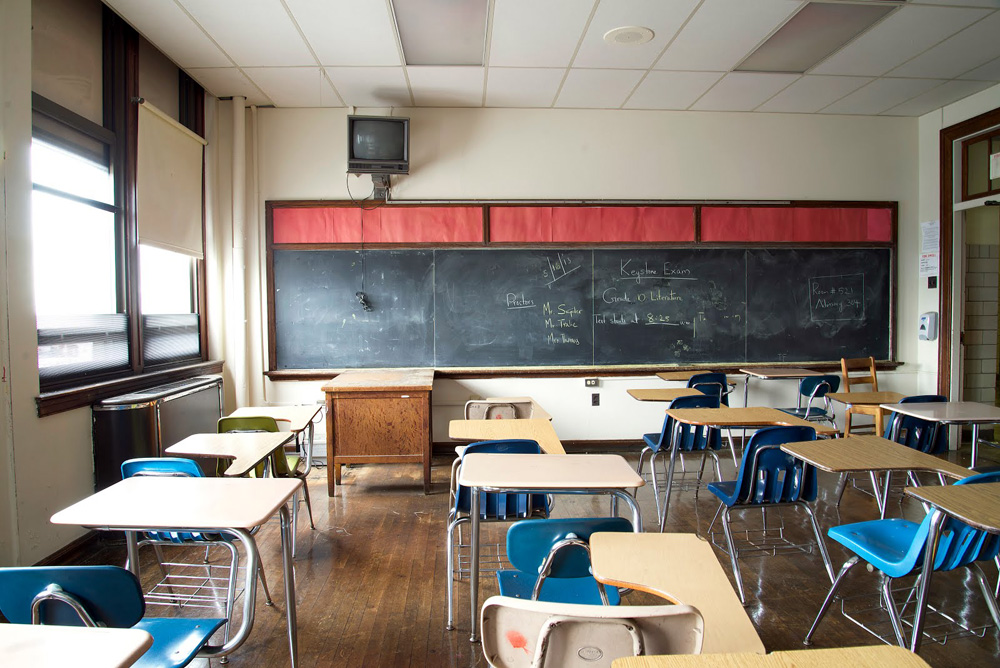
A classroom in Edward W. Bok Technical High School, a shuttered public school in Philadelphia. (Katrina Ohstrom)
Serious fans of science fiction understand that the best work in the sci-fi genre either uses the future or an alternate reality to provide a window into our present. Episodes of the Twilight Zone (1959–64), which I’ve rediscovered on Netflix during this pandemic, routinely imagined scenarios that made Americans consider the consequences of real threats like nuclear war or automation. Blade Runner (1982) asked what would happen when the line between human and artificial intelligence was no longer clear. More recently, Neil Blomkamp’s Elysium (2013) envisioned a future of wealth inequality in which the 1 percent live in a beautiful satellite above the Earth while the planet is given over to poverty and squalor.
By imagining plausible futures stemming from our present, these works shock the viewer into considering what will happen if we don’t rethink our priorities.
Jack Schneider and Jennifer Berkshire’s A Wolf at the Schoolhouse Door: The Dismantling of Public Education and the Future of School is not science fiction, but it could be the premise for a good film. The book asks us to imagine a future in which the growing movement of school privatizers in the United States totally have their way.