Warehouses Are Today’s “Dark Satanic Mills”
Working in a warehouse during a pandemic means taking your life in your hands — and doing it for poverty wages. An activist with Warehouse Workers for Justice in Illinois tells Jacobin the story of how he finally got fed up, how he and other workers are fighting back, and what would happen if every warehouse worker in the country took the day off.
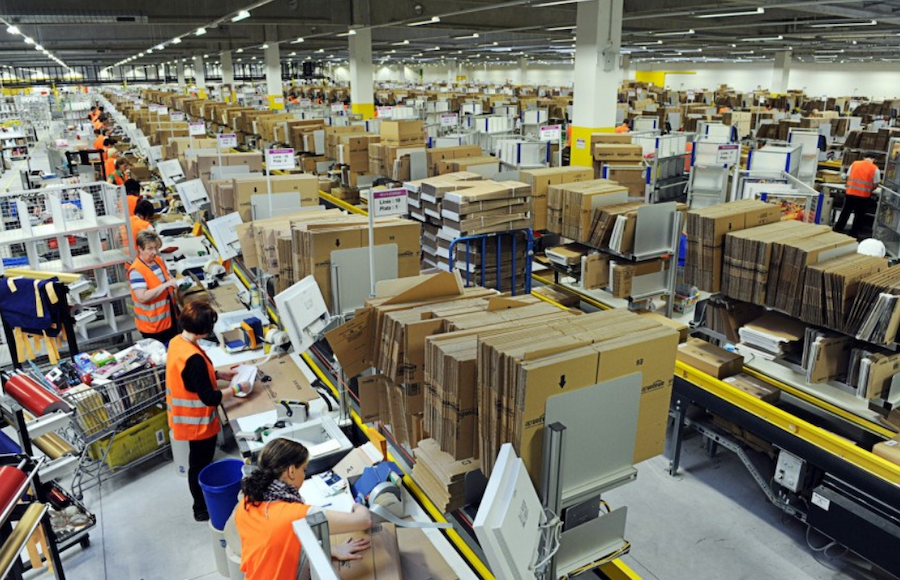
Workers in an Amazon warehouse. (Scott Lewis / Flickr)
One year into the pandemic, workers continue to suffer at the hands of employers who cut corners on health and safety. Government enforcement of existing safety standards is lackluster: the Occupational Safety and Health Administration (OSHA) is understaffed and at times seems willfully uninterested in investigating complaints. Indeed, it wasn’t long ago that the investigative website Reveal found that Indiana’s state OSHA had deleted citations and fines against an Amazon warehouse where a worker had died. The agency went so far as to advise the company on how to blame the worker for his own death. Meanwhile, the Centers for Disease Control and Prevention (CDC) has yet to set new air standards for workplaces, despite the urging of scientists.
That is the context in which warehouse work has taken place over the past year, with workers risking their health to make a living. While some facilities have avoided devastating outbreaks, others have not, and workers across companies complain of employers’ unwillingness to communicate with them about COVID-19 cases inside the warehouses. A recent report put together by Warehouse Workers for Justice and Chicago Workers’ Collaborative notes that warehouses have been second only to nursing homes in COVID-19 cases in Illinois, with at least 165 outbreaks at factories, warehouses, distribution centers, and food production facilities since July 2020. Of the food workers interviewed in the report, 65 percent said that either they or someone they knew at their workplace had contracted COVID-19. And 85 percent said that their employer either didn’t respond to workers’ complaints, retaliated against workers who spoke up with concerns about the employer’s handling of COVID-19, or took action that didn’t improve the situation.
In Joliet, Illinois, this is a particularly pressing problem: the city, just outside of Chicago, is a logistics hub. Joliet already has an Amazon warehouse, and there is currently a fight over a proposed development project, the Compass Global Logistics Hub by NorthPoint Development. Mars Candy, the world’s largest candy manufacturer, also has a warehouse in Joliet.