The British Monarchy Will Not Survive Late Capitalism — And Harry and Meghan Are Proof
The spectacle of Harry and Meghan’s reinvention as a standard-issue, new money California couple shows that the British monarchy’s ability to resist the cultural demands of late capitalism is reaching a breaking point.
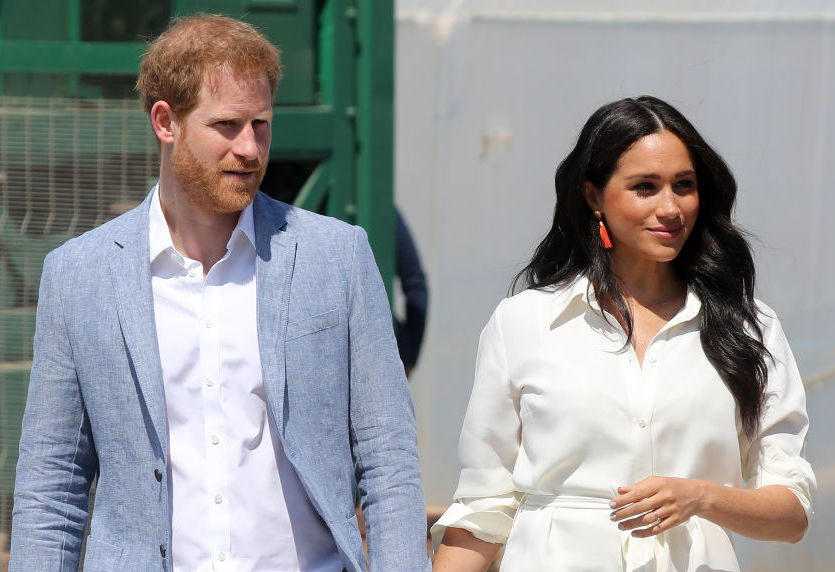
Prince Harry and Meghan Markle in Johannesburg, South Africa, 2019. (Chris Jackson / Getty Images)
In the unforgettable opening passage of his 2009 essay Capitalist Realism, the late Mark Fisher recalls a scene from Alfonso Cuarón’s Children of Men in which the film’s hero Theo (played by Clive Owen) visits London’s Battersea Power Station — best known in the popular imagination for its appearance on the cover of Pink Floyd’s 1977 album Animals. In the building, which seems to be at once a private and a government facility, Owen’s character encounters a number of famous cultural treasures, among them Picasso’s Guernica, Michelangelo’s David, and the famous inflatable pig from Floyd frontman Roger Waters’s 1977 cover design.
#/media/File:Pink_Floyd-Animals-Frontal.jpg)
The subtle power of the scene, for Fisher, lay in its depiction of iconic artworks desacralized by the commodifying pressures of late capitalism: David, now missing part of a leg, looks on as King Crimson’s “In the Court of the Crimson King” plays in the background and the owner’s pets play at its feet; Guernica, “once a howl of anguish and outrage against fascist atrocities,” sits with little fanfare as mise-en-scène in the dining area of an antiseptic bourgeois loft while guests are serenaded by a Handel aria; the iconic pig has returned to Battersea, though it has been clunkily repositioned so that it will be visible from the dining room window. The sculpture of Florentine Italy, ’70s prog rock, the Spanish Civil War, and baroque music alike: all seem on equal footing amid the atmosphere of bleak patrician decadence.
As Fisher observes, the building housing the treasures is itself an object of the same process: the once-functioning coal-fired power station (in real life partly decommissioned two years before its appearance on the cover of Animals) having been turned into a kind of “refurbished heritage artifact” in Children of Men’s imagined, though uncomfortably plausible London of the near future. (Fisher will regrettably never know quite how prophetic his interpretation was: in 2018, Battersea was purchased by the Malaysia-based sovereign wealth fund Permodalan Nasional Berhad and will soon house a mixture of luxury lofts, restaurants, retail outlets, a “Chimney Lift” tourist attraction, and a five hundred thousand square foot “campus” owned by Apple Inc.) That process, says Fisher (with an assist from Marx and Engels), amounts to the “transformation of culture into museum pieces” by the inexorable forces of global capitalism. “The power of capitalist realism,” he elaborates: