Freeman Dyson Refused to Let Go of His Optimism About the World
The renowned physicist and mathematician Freeman Dyson died early this year and would have turned ninety-seven today. His eternal and unshakable sense of optimism about the world despite its myriad miseries is desperately needed right now.
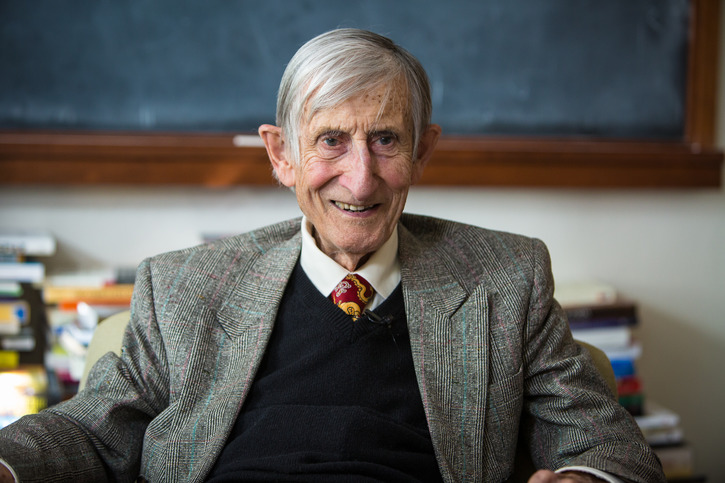
Freeman Dyson (1923–2020). (Institute for Advanced Study)
On February 28, just a few weeks before the United States plunged into lockdown, the world lost the visionary physicist and mathematician Freeman Dyson. Although widely celebrated for his expansive scientific achievements, eulogizers have given scant attention to his progressive political imagination and longtime identification as a pacifist and socialist.
Five years ago, when the New York Times asked him which writers he’d invite to a literary dinner party, Dyson chose three women he already knew so he “would not need to waste time on formal introductions”: the classical archeologist Joan Breton Connelly, the science fiction writer Mary Doria Russell, and me. He said he selected his guests because all of our books explored “the mystery of self-sacrifice,” of what inspired ordinary men and women to ignore their own self-interest for the sake of the greater good. The key to the future, he seemed to indicate, hinged on understanding the roots of altruism.
For Dyson, the mysteries of human behavior were just as deep and enduring as the mysteries of the universe. In the sheer breadth of his interests, Dyson embodied the ideal of the Renaissance man, widely knowledgeable across multiple fields of inquiry. In addition to his groundbreaking work in astrophysics and quantum mechanics, Dyson reveled in the humanities and social sciences, exploring big questions not everyone has the courage to ask.