To Talk About Racial Disparity and COVID-19, We Need to Talk About Class
It’s now widely understood that black Americans have been disproportionately hit by the coronavirus. But though mainstream commentators are willing to recognize this basic disparity, and the role of racism, they perpetually obscure the question of class.
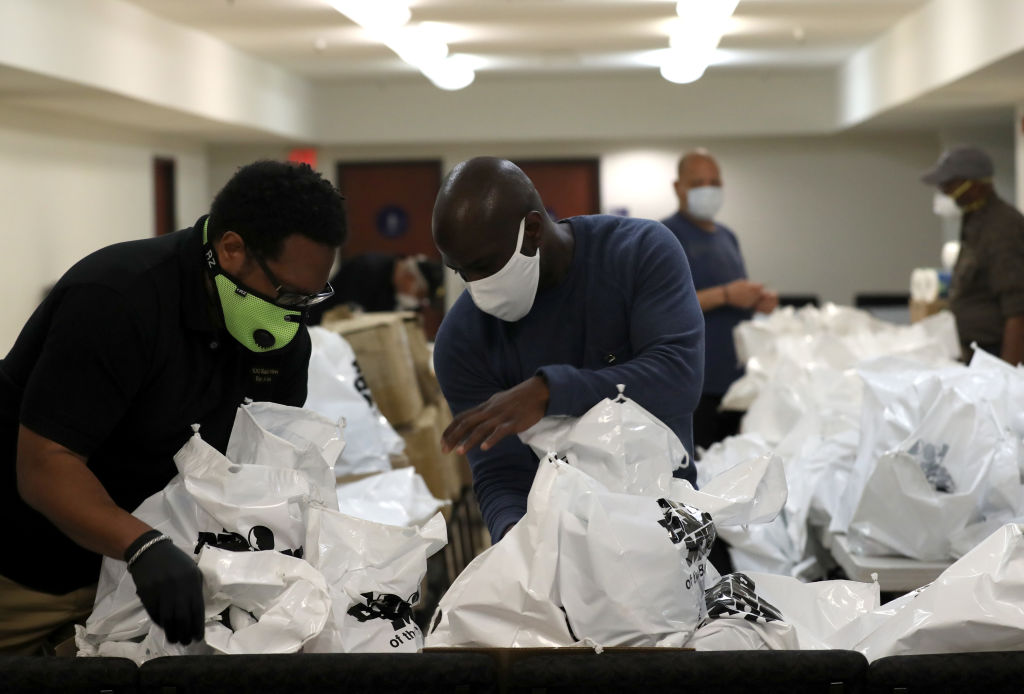
Volunteers with 100 Black Men of the Bay Area pack boxes with health care packages for homeless people on April 28, 2020 in Oakland, California. Justin Sullivan / Getty
As a great deal of recent public discourse makes clear, black Americans have been disproportionately impacted by the fallout from the coronavirus pandemic. Though hampered by limited and fragmented data, recent public health reports suggest that in eight states, blacks are at least three times more likely to be infected by coronavirus than their white counterparts, and nationally, blacks are twice as likely to die from such infections. County-level and city-level data have typically suggested similarly troubling trends. These realities largely mirror patterns of racial disparity that exist on a wide range of adverse social indicators.
As someone who studies gun violence, the recent discourse on coronavirus disparities has called to my mind long-standing narratives around gun violence and black men. While typically well intended, these disparity discourses share a number of problems that have often done more to obscure than to advance our understanding of these issues, as well as how we might effectively confront them. Such problems include: (1) the tendency to treat race as a biological category and to presume that racial identity is a discrete risk factor for coronavirus or gun violence, (2) the promotion of public health interpretations that focus on behavioral norms and lend themselves to austerity-minded interventions, and (3) the treatment of racial disparities as distinct from broader patterns of structural inequality. At the intersection of these discourses, moreover, epidemiological metaphors of racism and gun violence as “diseases” akin to coronavirus are often invoked in lieu of more nuanced and historically grounded analyses of these issues.
In the end, these accounts are largely devoid of class analysis and have little to offer in terms of meaningfully tackling these issues. We need an alternative lens for understanding and addressing the common roots of these issues.