In Sports and Everywhere Else, Collective Action Can Make Change
The history of American professional sports is inseparable from a history of protest. But never before has such a large cross-section of leagues been impacted by political action. We should celebrate the development.
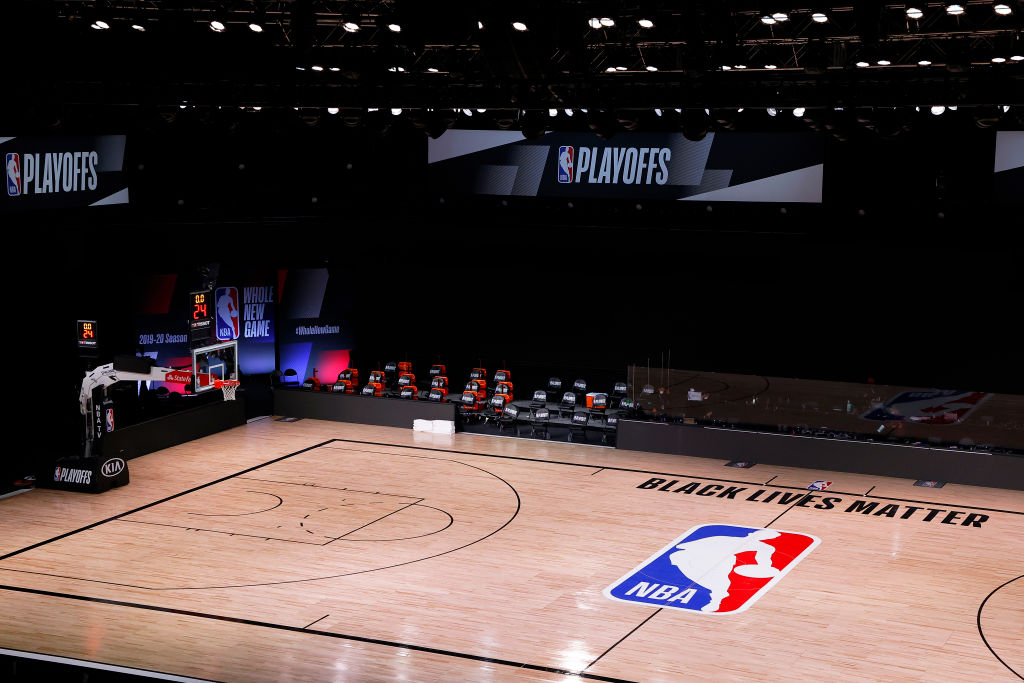
An empty court and bench is shown with no signage following the scheduled start time in Game Five of the Eastern Conference First Round between the Milwaukee Bucks and the Orlando Magic during the 2020 NBA Playoffs on August 26, 2020 in Lake Buena Vista, Florida. (Kevin C. Cox / Getty)
On Sunday in Kenosha, Wisconsin, police fired four bullets into Jacob Blake, severing his spinal cord and adding another chapter in the long history of US state violence against black Americans. On Wednesday, the NBA’s Milwaukee Bucks, scheduled to play that night in their playoff series against the Orlando Magic, did not. Instead, they went on strike, issuing a statement that read, in part, “It is imperative for the Wisconsin State Legislature to reconvene after months of inaction and take up meaningful measures to address issues of police accountability, brutality and criminal justice reform.”
The history of American professional sports is inseparable from a history of protest. Individuals from Muhammad Ali to Colin Kaepernick to Mahmoud Abdul-Rauf to Craig Hodges to John Carlos and Tommie Smith to Jackie Robinson and Pee Wee Reese have used their platform as professional athletes to advance progressive ideals in an industry and a nation that have historically been regressive.
On the collective front, in 2016, after the police murders of Philando Castile and Alton Sterling, players from three WNBA teams wore shirts during warm-ups decrying their killings; others around the league used their postgame press conferences to highlight criminal justice reform and police brutality rather than the games. In 1964, just before the first-ever televised NBA All-Star Game, the players refused to leave the locker room until demands for better working conditions were honored. Three years earlier, Bill Russell and the Boston Celtics refused to play in an exhibition game in Lexington, Kentucky, after multiple businesses refused to let them enter during the road trip.