The Global South Needs More Than Just Debt Relief
The G20’s plans to postpone 76 emerging countries’ debt repayments are a band-aid on fundamental injustices in the global economy. Rebuilding the Global South after the pandemic will require a complete upending of the international order — and the defending states' sovereignty rather than financial markets'.
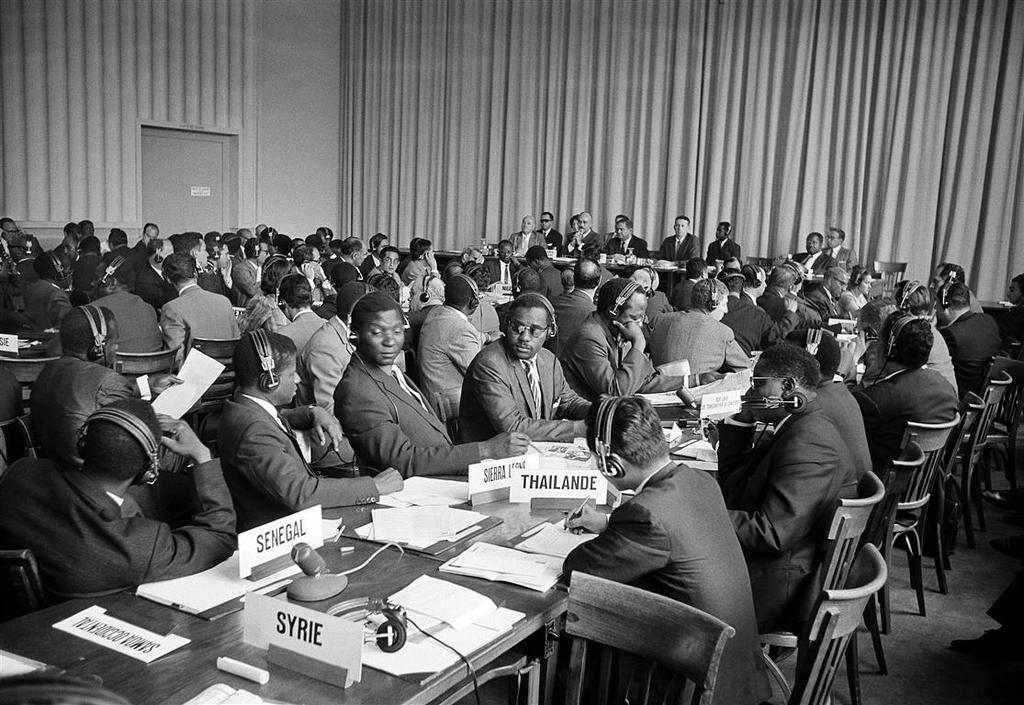
First session of the UNCTAD Conference, Geneva, Switzerland, March 23 to June 16, 1964. UNCTAD / Flickr
On April 15, the Group of Twenty (G20), an international forum that assembles governments, central bank governors, and international organizations, endorsed a suspension of debt service for seventy-six countries from the Global South. This was not quite debt cancellation, but a postponement of payment.
Granted on a case-by-case basis, this measure only concerns bilateral debt, and therefore excludes multilateral debts and those owed to the private sector. A few weeks later, on May 13, a coalition of three hundred parliamentarians led by Bernie Sanders published a letter calling on the International Monetary Fund (IMF) to provide “extensive debt forgiveness” for these same countries.
Since the first outbreak of the COVID-19 pandemic, the question of debt relief (or at least suspension of debt) has become a prominent matter of public debate. Emergency health and social expenses, added to collapsing economic activities, have left many countries in a dramatic budgetary situation, with very high levels of indebtedness and an alarmingly low capacity to face the coming economic crisis.