Disaster Capitalism Is Coming for Public Education
While educators across the country struggle to support and teach their students during distance learning, state and federal legislators are preparing to slash public education budgets. Defending public education during the coronavirus will require solidarity across the public sector.
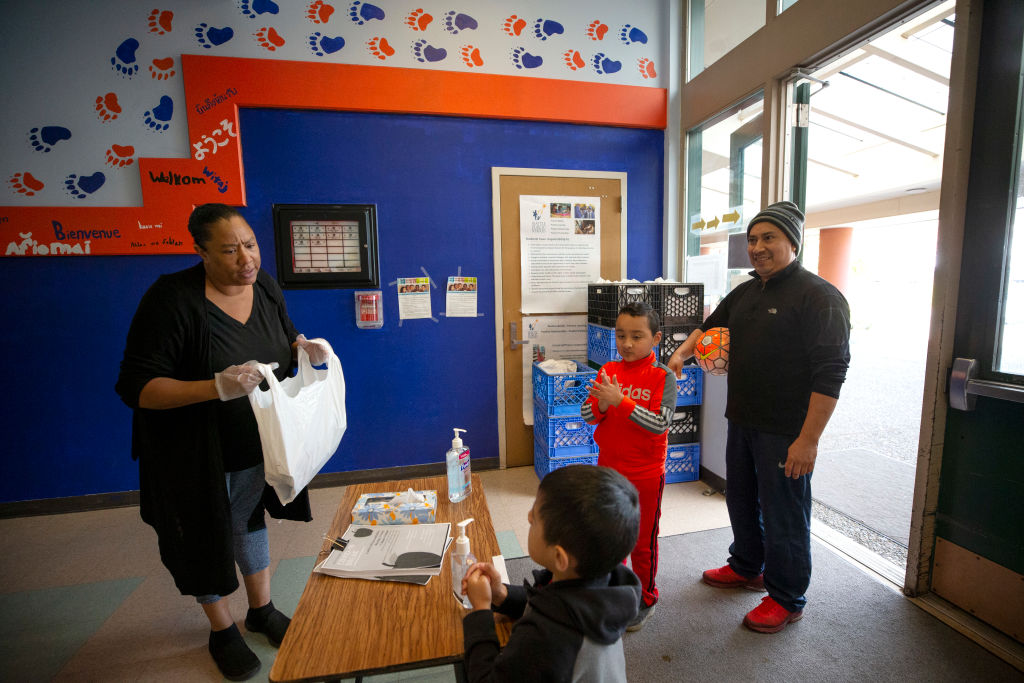
Cynthia Wright asks students what they would like in their lunch bags, at Bailey Gatzert Elementary School on March 18, 2020 in Seattle, Washington. As a result of all schools in Washington state being closed, Seattle Public Schools is providing carry-out meals to students during lunch hours. Karen Ducey / Getty
Public education has been under attack for decades, as opponents of teachers’ unions and public goods of all kinds have used everything from charter schools, hard-line negotiating against educators, budget cuts, philanthropic giving by austerity-minded rich people, and more to try to privatize and weaken teachers’ collective power. The state of public education has long been dire. And coronavirus has made things worse.
While educators are overwhelmed with managing the chaotic transition to distance learning and trying to meet the needs that school buildings once did, states are trying to solve the revenue crisis and lack of federal aid by drastically cutting funding for public education. If states reduce education spending by the 15 percent projected by the Learning Policy Institute’s Michael Griffith, the country could lose 319,000 teaching positions. That’s counselors, nurses, reading intervention specialists, special education aides, speech therapists, basketball coaches, general education, art and music teachers, and more.
This would be an even greater loss than that of the Great Recession, when states cut education spending by 8 percent, and over 120,000 education jobs were eliminated. (An additional 275,000 teaching positions would have been cut, if not for $97.4 billion from the American Recovery and Reinvestment Act of 2009.) Public education has still not recovered from these losses: in many places, the number of educators and state funding remains below 2008 levels.