How Chicago Teachers Won a Nurse in Every School
The recent Chicago Teachers Union strike put adequate school staffing at its center, including putting a nurse in every school. A school nurse explains how the union won that demand.
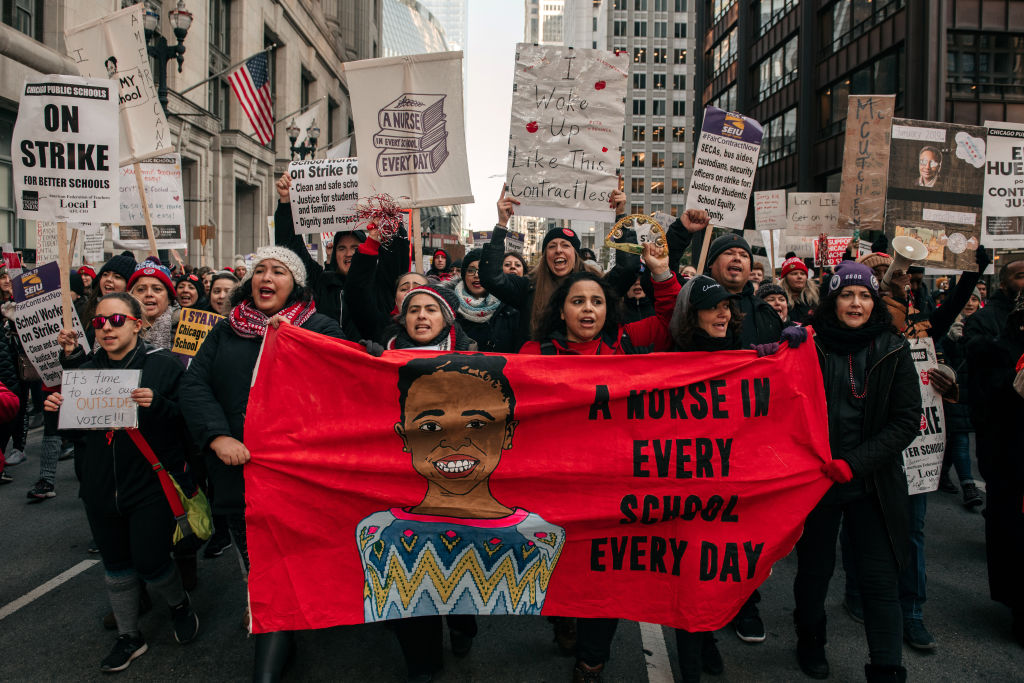
Thousands of demonstrators take to the streets, stopping traffic and circling City Hall in a show of support for the ongoing teachers’ strike on October 23, 2019 in Chicago, Illinois. Scott Heins / Getty Images
A colleague of mine came to the 2019 Chicago Teachers Union (CTU) strike picket line with the same sign she had made for the 2012 strike. It outlined the cost of various medications — updated with 2019 corporate price gouging — and ended by stating, “A nurse for every school is priceless.” That demand, for a nurse in every school, has been around for a while in Chicago Public Schools (CPS). It was a central demand of the strike this year — and one that the recently ratified contract takes great strides toward implementing.
From a strict legal standpoint, due to a 1995 state law engineered by CPS’s chief negotiator Jim Franczek, CTU was not allowed to strike for more nurses or over any non-wage issues. While pay-related disputes remained on the table until the end, an argument could have been made that CTU was in no position to strike over nurse, counselor, and other staffing issues, or capping class sizes, things that directly impact our students’ learning conditions. Yet we did anyway.
The state of nursing in our schools has long been poor. A study by the CTU Education Policy Department in 2016 outlined CPS’s long-term addiction to outside agencies that provide nursing services to students. The district claimed it was impossible for them to find nurses to work in CPS. But somehow these private companies have located two hundred of these impossible-to-find workers — and made a profit while doing so. Over the next five years, these agencies will largely be phased out, and these currently subcontracted workers can become CPS-employed nurses.