How Capitalism and Other Viruses Are Ravaging the Global South
Across the Global South, the coronavirus crisis has highlighted how IMF “structural adjustment” policies have undermined public health care. But the devastation wrought by the economic shutdown also owes to a longer-term ill: an exploitative global trade regime where the poorest countries finance the rich.
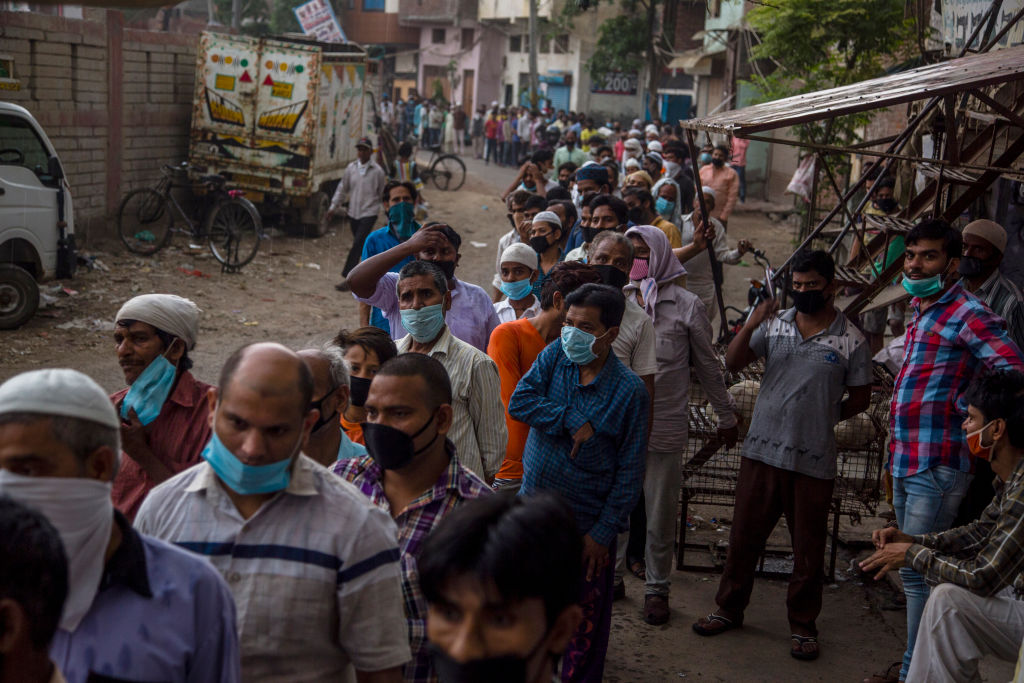
Indians stand in queue to receive free food in the Mustafabad area which was recently affected by riots, as the country relaxed its lockdown restriction, on May 14, 2020 in New Delhi, India. (Yawar Nazir / Getty Images)
COVID-19 inflicted unprecedented damage across the world within weeks — but it could only do so because it joined forces with another far more malignant and tenacious virus infesting the planet. Their combined action has exposed and deepened the fault lines of the world order in which this other virus thrives. Its breeding ground is the Global North, its preferred channel of dispersion economic hegemony, its main mode of replication the trade regime — and its main victims, farmers and laborers in the Global South.
The neoliberalism that wealthy countries also shove down others’ throats has exacerbated poverty and ruined the Global South’s social welfare and public health systems. Cuba’s resistance to this “force-feeding” — despite punitive embargoes — left it capable of sending medical teams around the world to tackle the pandemic. But in most of the Global South, the impoverished majority are left with no recourse to government support or health care while food riots and famine loom on the horizon.
Global financial structures — the trade regime, the “structural adjustment” policies pushed by international financial institutions (IFIs), debt servicing, and tax havens — have enforced austerity and privatization, and siphoned colossal amounts of money out of poor countries into rich ones, stripping the former of public services and leaving them strapped for cash and medical supplies.