In Japan, the Pandemic Has Shattered Abe Shinzō’s Great Power Dream
Abe Shinzo’s government was slow to respond to COVID-19, lagging behind neighbors like South Korea. The public health crisis has been worsened by the recklessness of Abe’s foreign policy, which relies upon an erratic US sponsor whose bases are a vector for spreading the disease.
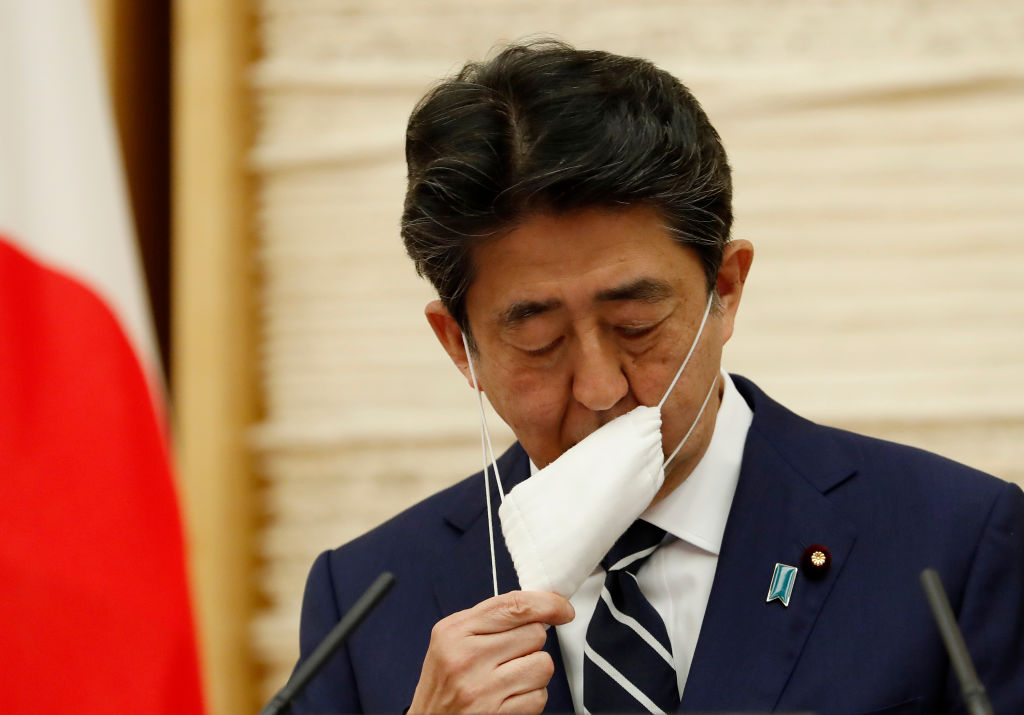
Japan’s prime minister, Shinzo Abe, takes off his protective mask as he begins his news conference on May 25, 2020 in Tokyo, Japan. Kim Kyung-Hoon — Pool / Getty
The year 2020 should have been a triumphant one for Japan. The omens were good. May 2019 saw the inauguration of the new “Reiwa” imperial reign, after the voluntary abdication of the Emperor Akihito in favor of his son Naruhito. Soon after, in November 2019, Abe Shinzō became the longest-serving prime minister in Japanese history.
With Abe at the helm, now in his fourth term, Japan expected to present itself to the world at the Tokyo Olympics as having recovered from the triple catastrophe of 2011 — the Fukushima earthquake, tsunami, and nuclear meltdown — and the long period of economic doldrums that followed, celebrating the Olympic games as a moment of renewal and hope. Abe would then fulfill his lifelong ambition by revising Japan’s 1947 constitution, establishing the country as a great power, with armed forces able and ready to project national strength on the world stage.
But it was not to be. In December 2019, China notified the World Health Organization (WHO) of the mysterious virus that was to become known as COVID-19. From an epicenter at Wuhan in central China, it began to spread, surfacing in Japan by mid-January. On January 20, the WHO declared a Global Health Emergency, and on March 11, it branded the crisis a pandemic.