China Is Not the Enemy — Neoliberalism Is
China’s united response to COVID-19 is often painted as a reflection of authoritarian “Asian values.” But the collective mobilization relied on real public support — a temporary social truce that today threatens to fracture.
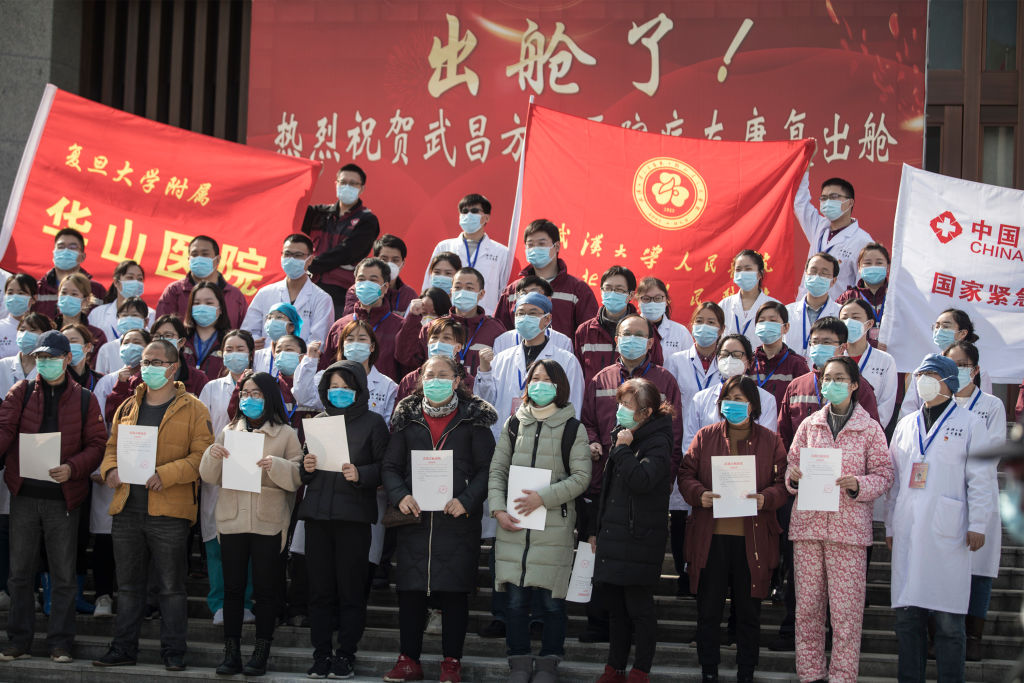
Discharged COVID-19 patients and medical professionals pose for photos as they leave Wuchang Fang Cang makeshift hospital, which is the latest temporary hospital being shut down, on March 10, 2020 in Wuhan, Hubei province, China. Stringer / Getty
Based on all we know, China has been comparatively successful in containing the spread of COVID-19 domestically beyond Hubei Province. Many observers attribute this to Chinese authoritarianism. According to this argument, a China unconstrained by democratic principles or human rights could impose a medieval-style lockdown by means of cyber surveillance; in addition to its undemocratic political system, China benefited from Asian values and a collectivist culture.
In a word, it’s all about Chinese exceptionalism. It is claimed that the Chinese approach would not be possible in Western democratic societies because of our concern for individual freedoms. China’s handling of the crisis is “othered,” just as the virus itself was initially Orientalized as a “Chinese problem.” Its experience is thus rendered irrelevant to those of us living in the United States or Europe.
However, such a focus on “authoritarianism” versus “democracy” or “East” versus “West” misses the core of China’s COVID-19 response. It feeds into Sinophobia of the kind that is increasingly dangerous in times of the so-called New Cold War. Rather, to make sense of China’s handling of the COVID-19 crisis, we have to place its response in the larger political economy context.