How Colonialism and Austerity Are Shaping Africa’s Response to the Coronavirus
African countries have shown impressive ingenuity in dealing with the coronavirus. But the legacies of colonialism and Western-imposed austerity have left them ill-equipped to attack the deadly virus.
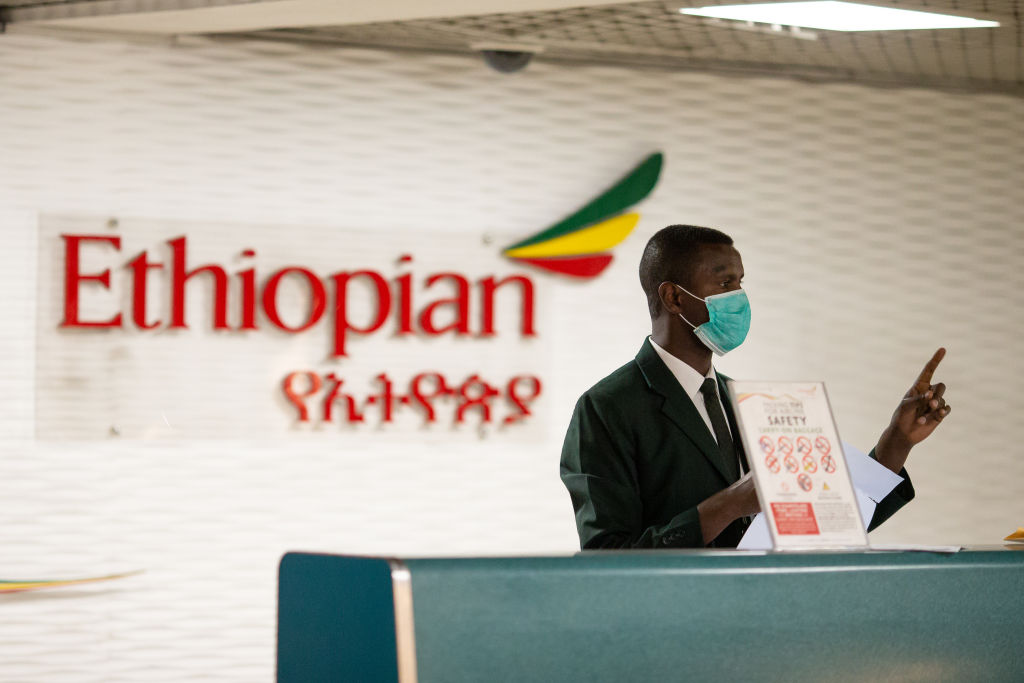
A member of Ethiopian Airways staff wears a face mask at Addis Ababa Bole International Airport on January 31, 2020 in Addis Ababa, Ethiopia. Luke Dray / Getty
Since February 14, when Africa’s first case of COVID-19 was recorded in Egypt, the number of confirmed cases across the continent has risen to roughly 130,000 and caused 3,800 deaths. Though tragic, these numbers pale in comparison to the pandemic’s devastation in Western Europe and the United States. New York City alone has suffered well over five times the number of deaths as Africa’s fifty-four countries. And while experts point out that the true scale of infections in Africa has likely been concealed by insufficient testing, a recent World Health Organization (WHO) analysis also suggests that the virus is spreading more slowly on the continent than elsewhere.
Observers have offered a variety of explanations for this comparably low level of COVID spread: the continent’s relatively young population; governments’ decision to implement lockdowns earlier than their Western counterparts; and countries’ innovative responses to the crisis, such as Ethiopia’s door-to-door survey that recorded the symptoms and travel history of each of the 5 million residents of its capital city, Addis Ababa.
Despite these glimmers of hope, experts caution that it is still too early to say how the pandemic will play out in individual countries, much less in Africa as a whole. While many African nations have experience responding to acute public health crises like the deadly 2014 Ebola outbreak, many of the continent’s public health systems are wracked by wider vulnerabilities and inequities. Neoliberal economic adjustment programs in the 1980s and early 1990s, followed by decades of austerity measures and underinvestment in public health, left much of the continent’s health systems in crisis long before COVID-19 arrived. Nor has Africa been left unscathed by the economic fallout of the pandemic. Many of its economies, dependant on commodity exports like oil and coffee beans, are now facing the possibility of fiscal, currency, and debt crises, prompting many governments to begin easing lockdowns even as infection numbers grow.