“A Little Flu” Could Be Fatal for Jair Bolsonaro
Brazil’s fragile health care system and densely populated cities threaten to turn the COVID-19 outbreak into a full-scale social collapse. President Jair Bolsonaro’s dismissal of the pandemic as a “little flu” is feeding dissent even among his allies — threatening to hasten the far-right leader’s downfall.
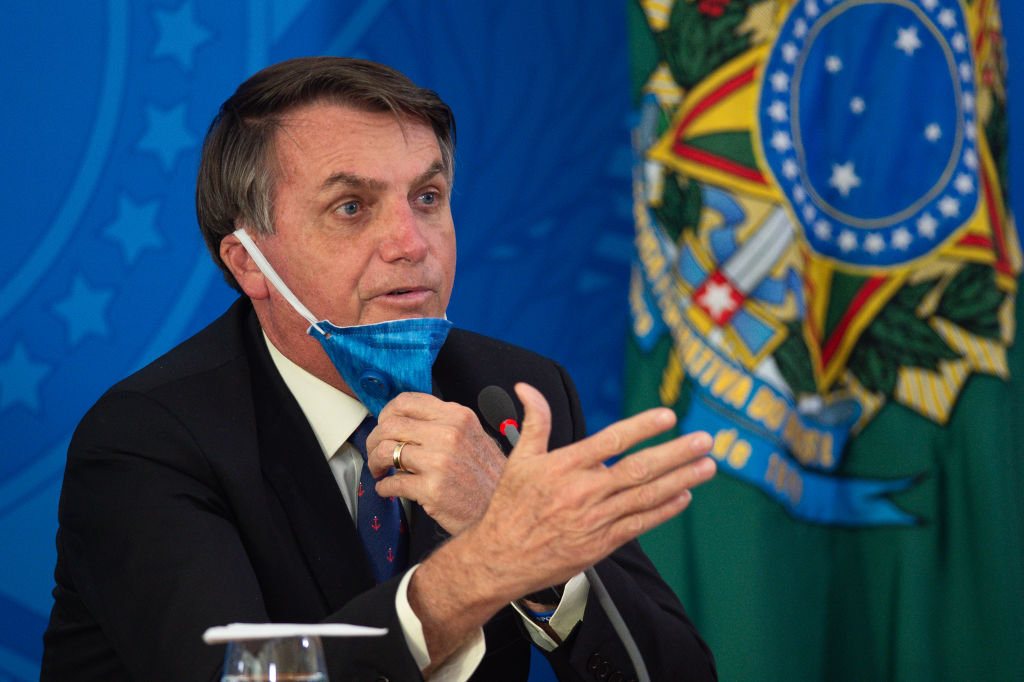
Jair Bolsonaro, president of Brazil, takes off his protective mask to speak to journalists during a press conference about outbreak of the coronavirus at the Planalto Palace on March 20, 2020 in Brasilia, Brazil.Andressa Anholete / Getty
March 2020 could go down as the month in which the tide finally turned against Brazil’s far-right president, Jair Bolsonaro. Recent weeks have seen noisy “panelaços” (pot-banging protests) against Bolsonaro across major cities. The last time the echoes of banging pots were regularly heard was in 2016, when they were directed against then-president Dilma Rousseff of the Workers’ Party (PT). She was removed that August after both Brazil’s Congress and Senate, confident that public opinion was behind them, voted to impeach her on flimsy charges of manipulating public accounts. Her successor, interim president Michel Temer, was also the object of panelaços and barely limped through the rest of Rousseff’s term.
However, such protests are hardly a scientific gauge of public opinion — they may simply represent a radicalization of segments of the population, concentrated in certain areas. The limited polling conducted since the coronavirus pandemic reached Brazil is ambiguous. On March 19, small pollster Atlas Político found that 64 percent disapproved of Bolsonaro’s handling of the pandemic and that 45 percent favored his impeachment — exactly tied with those opposed. However, 26 percent still considered his government to be “good” or “great” and 33 percent “average,” compared to 41 percent regarding it as “bad” or “terrible.” This showed almost no change from results a month earlier. In a poll published by Brazil’s leading polling firm Datafolha on March 23, focused specifically on the pandemic, 35 percent approved of Bolsonaro’s response, 33 percent disapproved, and 26 percent considered it “average.” However, there was widespread concern about the pandemic and greater disapproval of particular pronouncements made by the President. We will have to wait for further evidence over coming weeks to assess whether Bolsonaro’s popular support has genuinely begun to fracture.
It is not hard to see why it would have. Bolsonaro’s behavior in response to the emerging pandemic has ranged from clownish to sociopathic. When news of the spread of coronavirus first hit the headlines in early March, he dismissed it as a “fantasy.” However, as the crisis quickly escalated in Europe and members of his own team contracted the virus (and perhaps he himself, though he claims otherwise), total denial became a step too far even for Bolsonaro. Instead, he acknowledged it as a genuine problem, and briefly appeared to accept the growing consensus around the need for stringent social distancing measures. However, he then U-turned in spectacular fashion. In a special announcement to the nation on March 24, he dismissed the virus as a “gripezinha” (mild flu) only dangerous to the elderly. Subsequently, he has gone further, explicitly opposing restrictions imposed by state governors and the recommendations of his own health minister, Luiz Henrique Mandetta, by telling people to return to work. In addition to provoking a crisis of authority in the midst of a public health emergency, Bolsonaro almost certainly committed an impeachable offence when, earlier in the month, he encouraged and then physically embraced supporters at a protest against the congress and supreme court. Not only did this contravene the constitution, but also health ministry guidelines against large gatherings.