Austerity Is the Patient Zero of Coronavirus
The coronavirus is already exposing the profound damage a decade of Tory austerity has wrought on British society. And it’s about to get a lot worse.
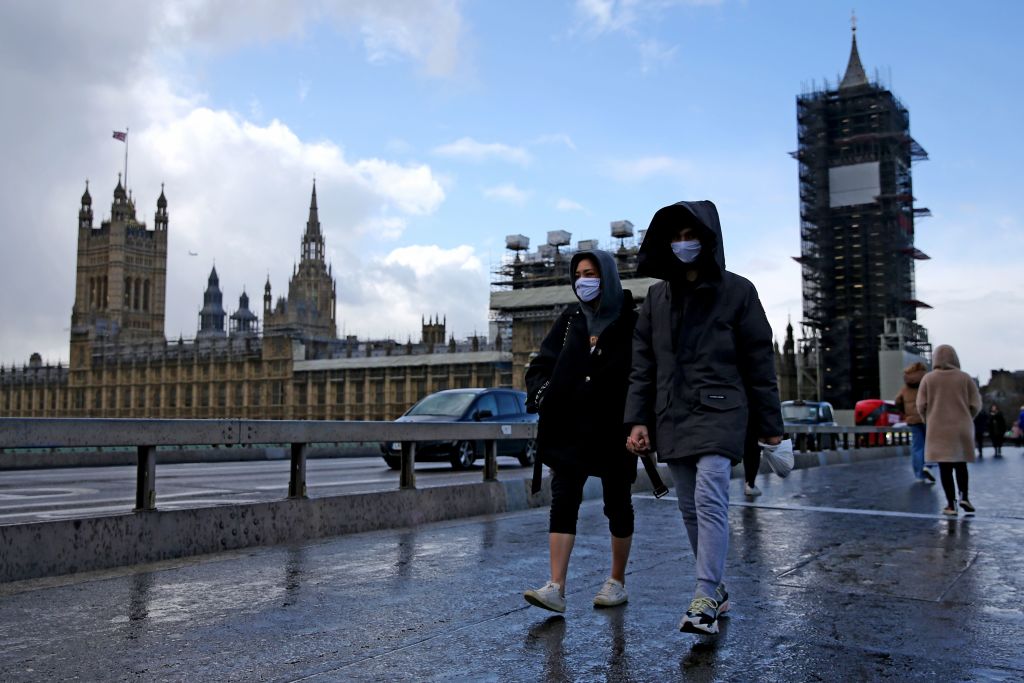
Pedestrian wearing a face mask walks along Westminster Bridge in front of the Houses of Parliament in London on March 12, 2020.Isabel Infantes / AFP via Getty
The infamous Typhoid Mary was first brought to public attention when a private investigator attempting to track down the source of multiple outbreaks of typhoid fever discovered the Irish cook had taken employment with multiple families over five years, leaving when they became ill and finding new posts elsewhere. Unwilling to stay in confinement and quit her job, Mary Mallon was forcibly quarantined from 1907 until 1910, when as an asymptomatic carrier of the bacteria she was released after signing an affidavit agreeing not to work in food preparation again. Now working as a laundress, Mallon earned far less than she had as a cook, so she changed her name and renewed her old duties, infecting at least twenty-five more people and killing two. In 1915, she was arrested again, and imprisoned in a sanitarium until her death after starting another outbreak.
Authorities in the United Kingdom are now facing conundrums similar to the bodies that dealt with Mallon in New York a century earlier as they attempt to prevent coronavirus deaths: how do you stop people going to work when they might be sick if doing so is financially prohibitive for them? In the UK, statutory sick pay is paid after three days of unpaid leave, and often requires a doctor’s note. Immediately after announcing public health advice urging people to self-quarantine for two weeks upon coming into contact with a coronavirus carrier or exhibiting symptoms, the government was asked how they expected people to follow the advice when for many people on low pay, and zero hours contracts, doing so will have a massive financial effect on their household’s ability to meet rent, keep food on the table, and pay the most basic utility bills.
Speaking to several people working in Parliament and government buildings, workers employed through outsourcing companies all told me if they felt symptoms were mild, they would still come to work. If they met a carrier and their employer did not know, they would not self-isolate. One cleaner in Parliament told me “If I’m sick, I will have to come in or the company will just cut my shifts. People are really, really scared. Nobody knows if they will have a job to come back to if they get sick for just one day, two days, it’s really serious if it is two weeks. I will just pretend I feel fine, take paracetamol and keep working.” Another outsourced contracted worker in a government department said “the government haven’t been giving us any good advice. Will they stop those companies from punishing us if we catch coronavirus? They just say we will get paid but if I don’t know if I will have a job in one month, two months, I will not take the risk of [self-isolating] unless I need to go to the hospital I am so sick. The risk is too much.”