Australia’s Coronavirus Travel Bans Feed Old Fears
With the spread of coronavirus now global, arbitrary travel bans such as those implemented by the Australian government are ineffective and nourished by old xenophobic anxieties. The solution to this crisis can only be a coordinated, international effort.
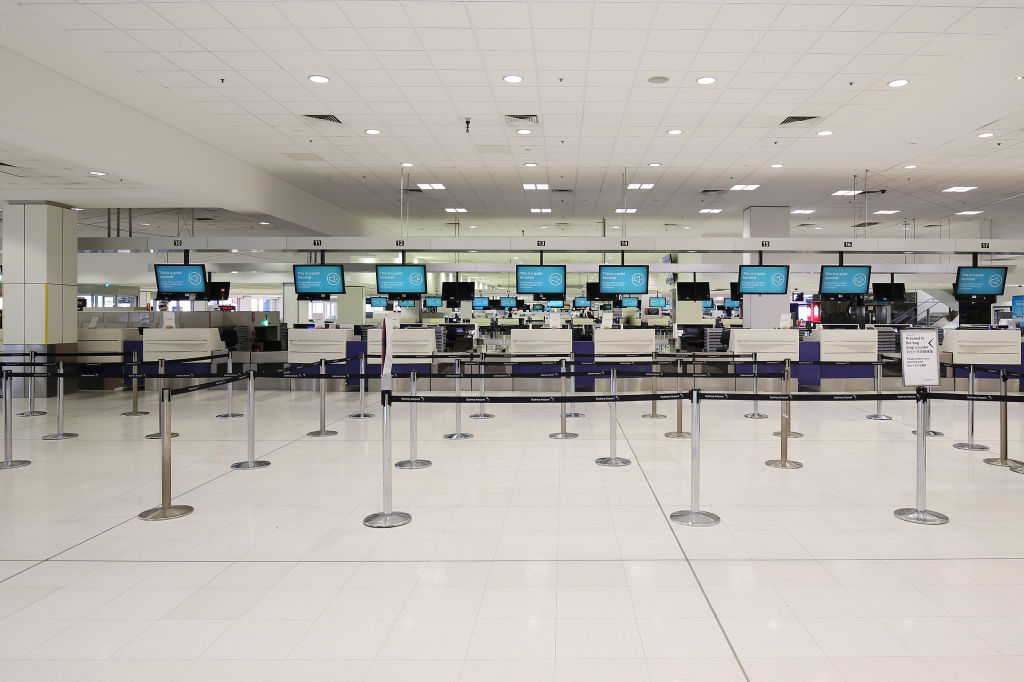
An empty departures hall is seen at Sydney Airport in Sydney, Australia, on Tuesday, Mar. 17, 2020.Brendon Thorne / Bloomberg via Getty
Over the last two months, the Australian government has been at the forefront of the global wave of travel bans purportedly implemented to contain the spread of Covid-19. By making border control a key element of his response to the pandemic, Prime Minister Scott Morrison has sought to regain the political ground lost during his disastrous handling of Australia’s bushfires during the southern summer. The pivot seems to be paying off, with Morrison’s coalition government receiving a recent bounce in public opinion polls.
What is striking is that no outright bans have been imposed on countries from the “Anglosphere” — that charming euphemism for England’s global network of white settler colonies — where the epidemic is rampant. With the government’s decision to place its heaviest restrictions on those coming from Asian countries instead, these travel bans can hardly be understood as the effective mitigation methods they purport to be; they instead reflect Australian colonial fears dating back to the nineteenth century and a xenophobia that has always been close to the surface.
Old Fears
When Scott Morrison suspended travel from China on January 31, his decision ran against the recommendation of the World Health Organization (WHO), which explicitly advises against travel restrictions, particularly over long periods of time. Their logic is that such measures are ineffective, “divert resources from other interventions”, and have negative social and economic side effects. Paying no heed to the expert advice, the government went on to ban travel from Iran on March 1, but did not restrict flights from Italy — despite Italy already having more confirmed cases of the disease (1701) than Iran (978) at that point in time. Three days later, South Korea was added to blacklist, while Italy remained exempt.