When German Liberals Teamed Up With the Far Right
Since 1945, Germany’s parliamentary parties have refused all alliances with the far right. That changed yesterday in Thuringia, when liberals and Christian Democrats teamed up with neofascists to throw the Left out of office.
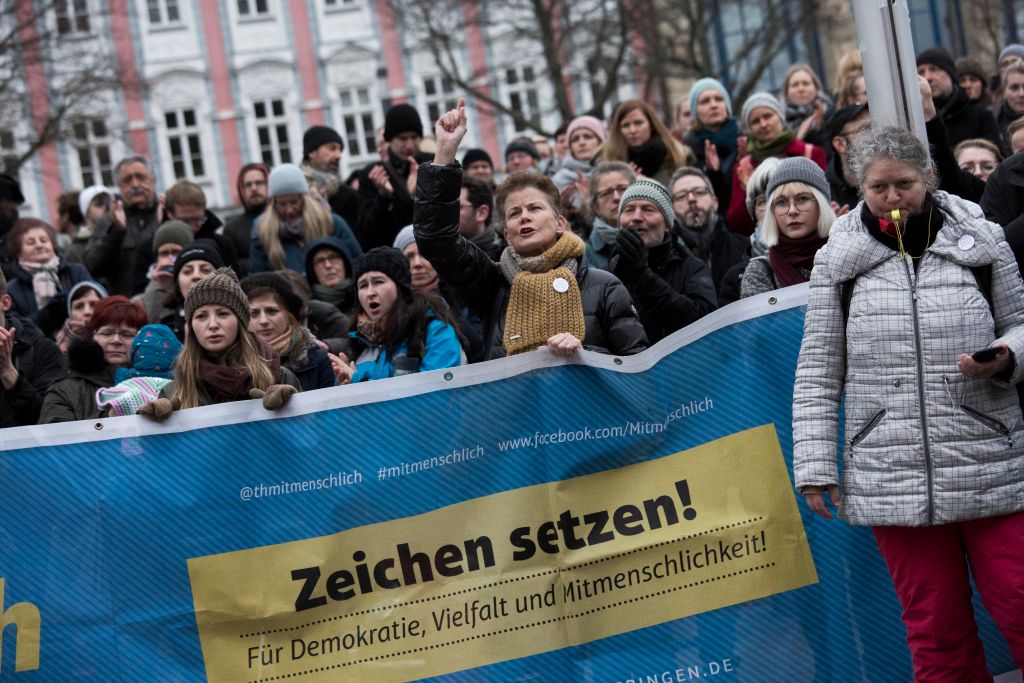
Protesters demonstrating against yesterday’s election of the new Thuringia governor gather outside the Thuringia state parliament on February 6, 2020 in Erfurt, Germany. The election has caused a political uproar after the centrist candidate of the German Free Democrats (FDP), a party that only received 5% of votes in Thuringia’s state election, was elected governor yesterday in elections within the parliament with the support of the right-wing Alternative for Germany (AfD). Carsten Koall / Getty
After months of political gridlock, on February 5, Die Linke’s only minister president, Bodo Ramelow, was ousted as head of Thuringia’s state government. He was replaced — for all of twenty-four hours — by Thomas Kemmerich of the liberal Free Democratic Party (FDP). That Kemmerich’s party received 5 percent of the vote in October’s election and he nonetheless managed to weasel his way into this role itself raised eyebrows — surely going against the spirit, if not the law, of parliamentary democracy.
Cause for much more alarm, however, is the way that the FDP pulled off this parliamentary coup. It was engineered with the tacit support of not just its traditional allies, the Christian Democrats (CDU), but the right-populist and increasingly far-right Alternative für Deutschland (AfD). In Thuringia, the party is led by Björn Höcke, the closest thing German politics has to an open neo-Nazi.
Kemmerich managed to stay in office for only twenty-four hours before public outrage forced him to resign. But regardless of how things play out, his election — and the fact that both the FDP and CDU initially went along with the plan — represents a new degree of normalization of the far right in Germany, and it says a lot about the neoliberal center in the country. Faced with a choice between a moderate center-left administration and a return to conservatism on the backs of far-right nationalists, it appears that a large chunk of the center preferred this latter option.