Don’t Expand the War on Terror in the Name of Antiracism
Declaring white nationalism a form of terrorism won’t combat white nationalism — but it will grant more arbitrary powers to a carceral state that preys on the most vulnerable.
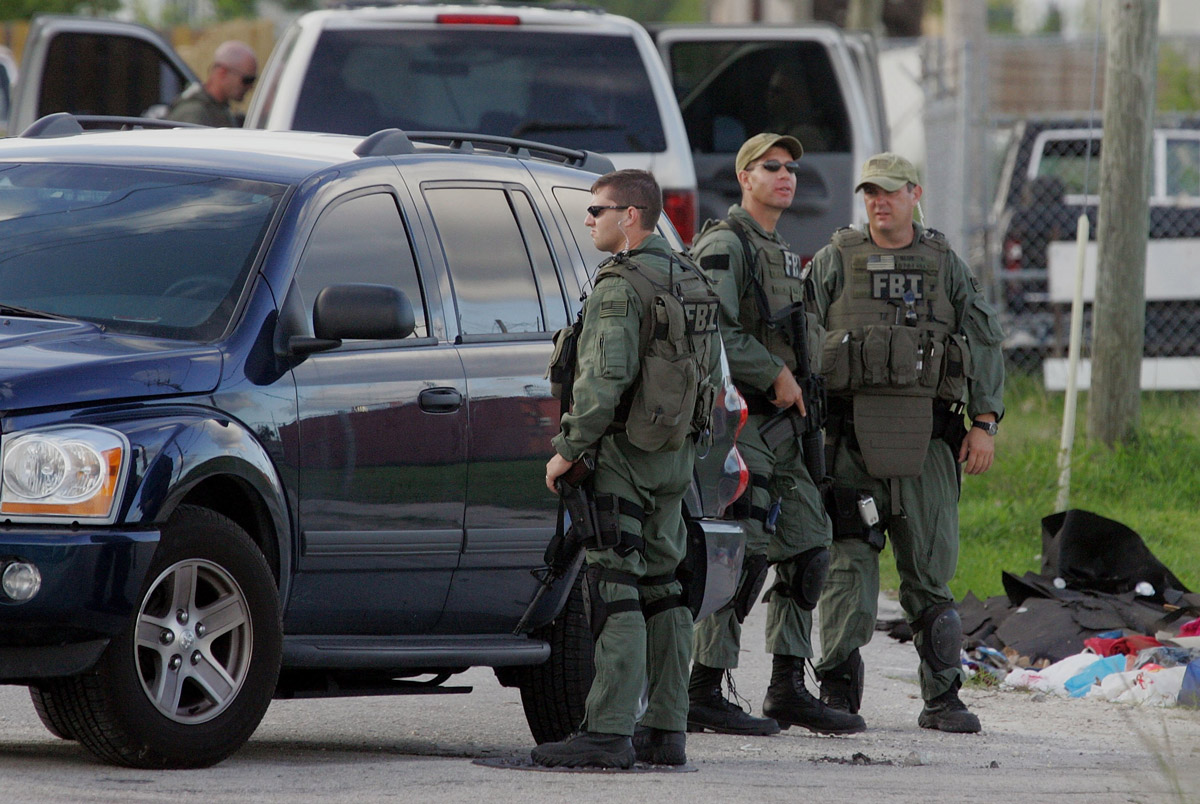
FBI agents conduct a terrorism-related investigation near housing projects on June 22, 2006 in the Liberty City neighborhood of Miami, Florida. (Joe Raedle / Getty Images)
Over the last few months, there have been growing calls to categorize white nationalism as a form of terrorism and to extend counterterrorism laws to explicitly target domestic terrorism, particularly white supremacist violence. The FBI Agents Association, which represents more than fourteen thousand active and former bureau agents, has called on Congress to make domestic terrorism a federal crime. Meanwhile, Representative Adam Schiff (D-CA), the chairman of the House Intelligence Committee, recently proposed a “Confronting the Threat of Domestic Terrorism Act,” citing the need to tackle white supremacist attacks. The legislation would expand the types of crimes that federal prosecutors could charge as domestic terrorism if the attorney general certified they were intended to intimidate a civilian population or influence government policy.
Many concerned about white supremacist violence support these proposals, highlighting the stark discrepancy in the ways the government treats Muslims and whites when they commit acts of political violence. What could be wrong with wanting to remove the racial biases in the application of counterterrorism? Why wouldn’t we want the full force of federal law to be applied to racist mass murderers? But to think that would be a mistake. It would actually end up worsening the problem of white supremacy and further expanding the reach of law enforcement. To understand why requires understanding how the word “terrorism” operates in US political and legal culture and the racially coercive powers its use enables. It also requires taking seriously the arguments of prison abolitionists who caution against “reforms” that actually give law enforcement more power.
Years and decades of organizing work and movements like Critical Resistance, Black Lives Matter, and #Not1More Deportation — along with influential analyses by scholars such as Angela Davis and Ruth Wilson Gilmore — have produced a substantive shift toward radically transforming the legal system — on the issues of ending cash bail and solitary confinement, on electing progressive district attorneys who promise what they won’t do instead of what they will, on real civilian oversight over the police, and prison abolition. That work has moved us beyond the assumption that only certain kinds of reforms for certain kinds of people could be advocated. That work — and the insights it has produced — has created the space and the urgency to take on federal “counterterrorism” law and policing, which has largely escaped sustained challenge.