Medicare for All Means “To Each According to Their Need”
A new study looks at other countries’ experiences with implementing single-payer health care systems. It finds that Medicare for All likely will not only cost less than many estimates suggest — it will also result in a more equitable distribution of care.
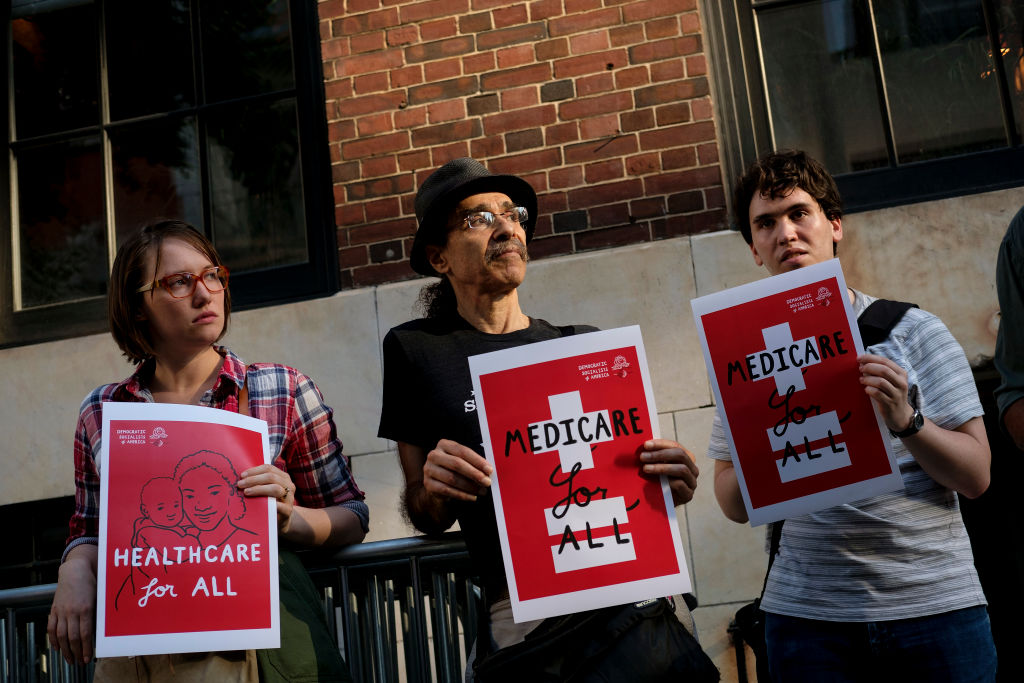
A small group of activists rally against the GOP health care plan outside of the Metropolitan Republican Club, July 5, 2017 in New York City. Drew Angerer / Getty Images
Most existing Medicare-for-All projections assume that when everybody in the United States finally has the ability to seek medical care that’s free at the point of service, people will head to the doctor in droves, and this will cause a major increase in overall health-care expenditures.
Researchers usually factor a large spike in utilization into their cost estimates for Medicare for All. For example, a recent estimate from the Urban Institute assumes that health-care spending will rise 20 percent because of more frequent hospital care and doctor visits. This contributed to their conclusion that federal expenses would increase $32 trillion over ten years, an especially high estimate.
But what if the common wisdom about increased utilization is wrong? A new paper in the Journal of General Internal Medicine authored by Adam Gaffney, Steffie Woolhandler, and David Himmelstein, who teach at Harvard Medical School and lead Physicians for a National Health Program, presents some evidence to the contrary. The authors reviewed thirteen universal coverage expansions in eleven wealthy nations over the course of eight decades, and they found that overall increases in use of services were mostly either modest or nonexistent.