Mafiosi of the World, Unite
Anti-mafia authors, police investigators, and far-right militants in Italy have a new obsession — organized crime by Nigerian citizens. But sensationalism about Nigerians importing “black magic” and “bloodthirsty violence” from afar fails to grasp the root of the problem — the criminal forms of organization that pervade Italian capitalism as a whole.
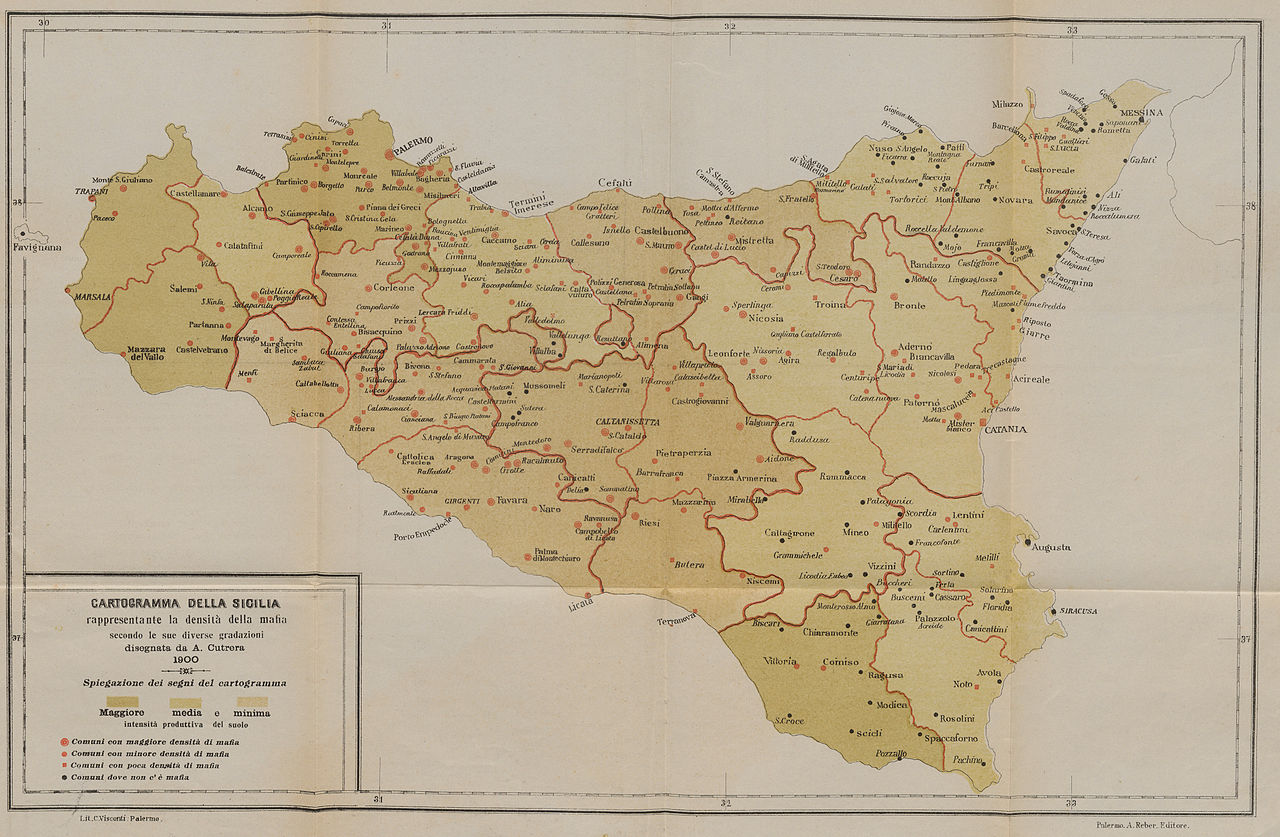
A map marking towns with Mafia activity in Sicily in 1900. Towns with Mafia activity are marked with red dots. Towns with no Mafia activity are marked with black dots, 1900.Antonino Cutrera / Wikimedia
Every age gets the conspiracy theory it deserves. Suitably, the current conjuncture in Italy has produced a new obsession on the far right, in the form of the Nigerian mafia. In a period in which immigration has dominated the political agenda, the murder of eighteen-year-old Pamela Mastropietro by a Nigerian man last January, on the eve of national elections, as well as a series of high-profile arrests of Nigerian gang members, have provided the Italian right a key tool for whipping up racist sentiment. And the obsession has spread. Today, the Nigerian mafia is subject of daily articles on local news sites, books by small publishers, investigations by carabinieri, and think-pieces by philosophers, anti-mafia authors, and neofascists alike. It has been described as the evillest of all criminal networks, the most bloodthirsty, even overtaking the horrors of Cosa Nostra.
Whatever their basis in reality, such theories are worth listening to. It was, after all, a little-read far-right blog that first accused international NGOs of colluding with Libyan people traffickers — a theory that provided the basis for former interior minister Matteo Salvini’s Security Decree criminalizing sea rescue. Here, a conspiracy theory had disastrous consequences — indeed, ones that the new government has still done nothing to mitigate.
Similarly, the far right has made legislative proposals responding to the fears being stoked by their own propaganda, for instance sending troops into Castel Volturno (a city with a large West African population, infamous for its crime syndicates) or creating special courts for trying the crimes of foreign citizens. Even though there are perhaps 100,000 Nigerian citizens in Italy, the presence of this small population is making waves throughout political life and beyond.