Politics Is Not Arithmetic
UBI advocates have a habit of mistaking politics for arithmetic. Proving that a policy is mathematically possible isn’t enough — and it can distract from more compelling left priorities.
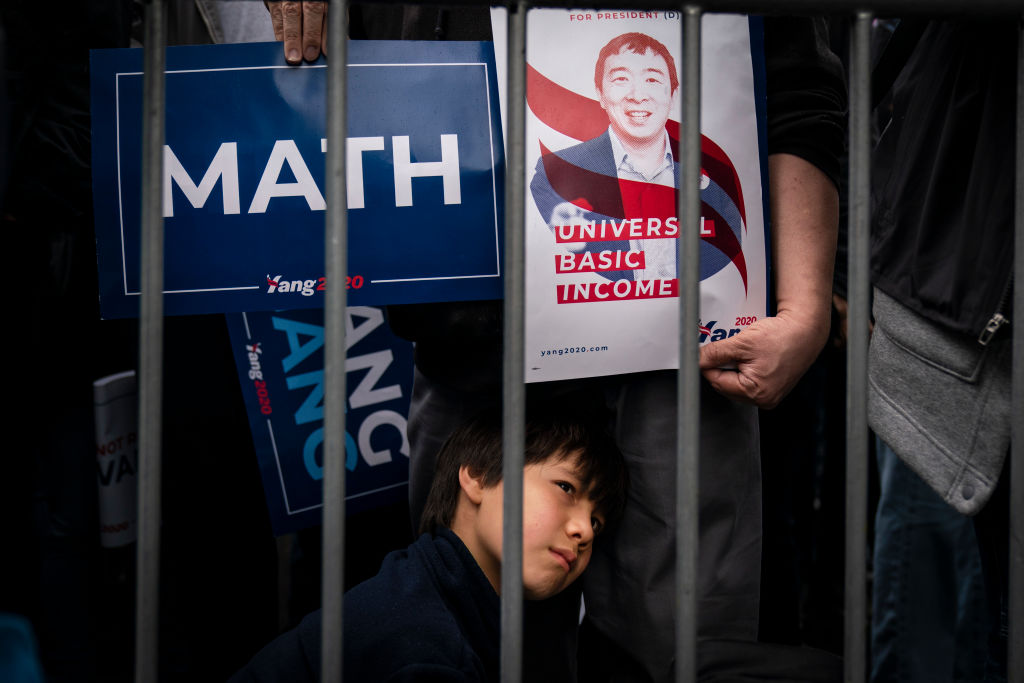
Isaac Tom, 10, listens as Democratic presidential candidate Andrew Yang speaks during a rally in Washington Square Park, May 14, 2019 in New York City. One of Yangs major campaign promises is a universal basic income of $1,000 every month for every American 18 years and older. (Drew Angerer / Getty Images)
“Politics is not arithmetic.”
In a response to my critique of Andrew Yang’s universal basic income (UBI) proposal, my friend Matt Bruenig of the People’s Policy Project claims that there is $5 trillion in annual capital income available to pay for a $3 trillion UBI.
There are two problems with this claim, one a matter of national income accounting, the other — the much more important one — of political economy.