The Heartland Institute’s Very Stupid New Medicare for All Report
A right-wing think tank just released a study slamming Medicare for All. It brings us no pleasure to inform you that its analysis is amateurish and riddled with errors.
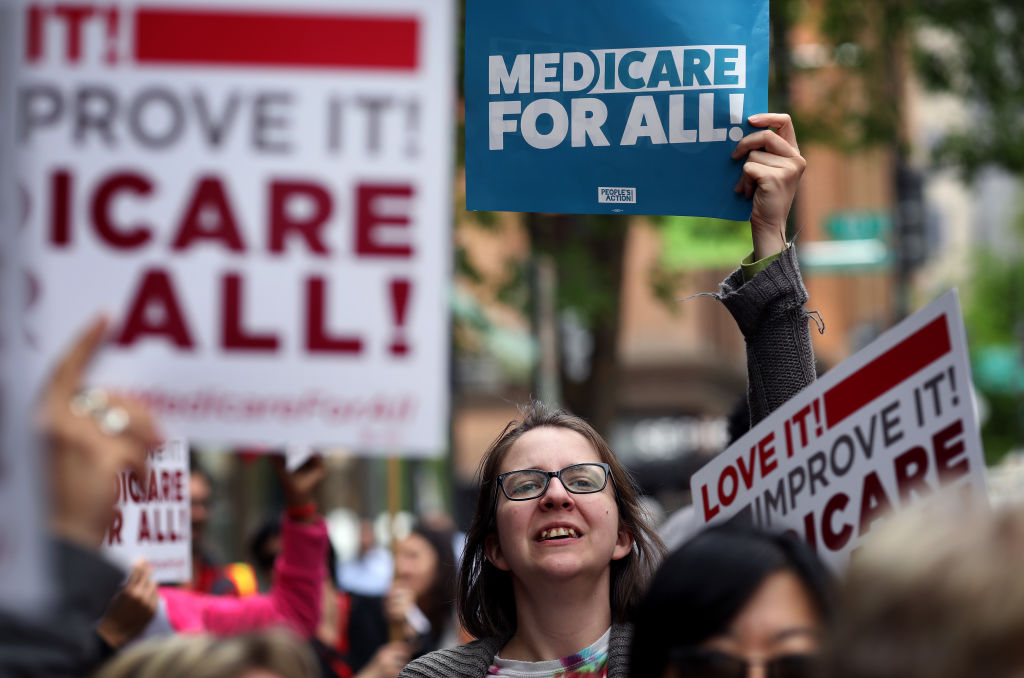
Protesters supporting Medicare for All hold a rally outside PhRMA headquarters April 29, 2019 in Washington, DC.Win McNamee / Getty
The Heartland Institute’s Justin Haskins put out a paper purporting to be a distributional analysis of Medicare for All. The paper is one of the shoddiest think tank reports I’ve ever seen, raising the usual question about conservative think tank output: intentionally deceptive or merely incompetent? I will not answer that question in this post, but I will break down just how bad Haskins’s paper is.
How to Do an M4A Distributional Analysis
The goal of a distributional analysis is to determine how much better off (or worse off) people at different income levels will be after we transition to a Medicare for All system. To conduct such an analysis, you need to do three things:
Add up all the money spent on health care in our current system ($4.562 trillion in 2022) and allocate that money to each household based on how much they personally pay. This includes how much they pay for Medicaid taxes, Medicare taxes, premiums, foregone wages (so employers can pay premiums and Medicare taxes), and out-of-pocket spending.
Add up all the money that would be spent on health care under Medicare for All ($4.469 trillion in 2022 according to Blahous) and allocate that money to each household based on how much they personally pay, which in an M4A system is just Medicare taxes and foregone wages (so employers can pay Medicare taxes).
Compare the allocation in (1) to the allocation in (2) to see how things have changed for households at different income levels.