Why the Bronx Burned
There’s a popular narrative that blames the blight and decline of the South Bronx in the 1970s on the working-class people who lived there. But a new film shows that it was landlords and the state who were responsible for the famous fires that ravaged the Bronx.
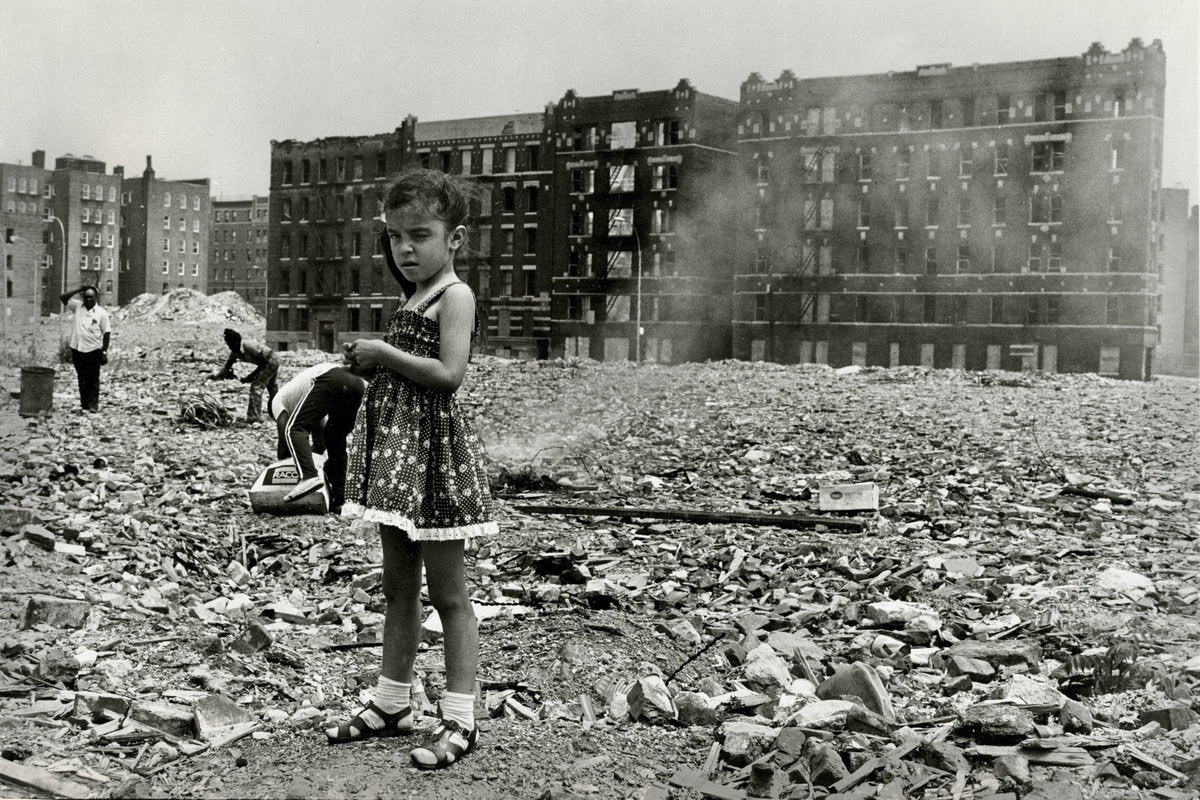
A young girl stands outside in the South Bronx in the 1980s. (Perla de Leon)
In the postwar era, the South Bronx witnessed a demographic shift as African Americans and Puerto Ricans joined foreign-born Irish, Jewish, and Italian immigrants. Pushed out by urban renewal and immigration policies, they arrived to the South Bronx on the heels of large-scale transformations including residential segregation spurred by federal housing policies, deindustrialization, and a looming fiscal crisis. Beginning in 1972 entire South Bronx neighborhoods burned down. Everyone seems to know the story by heart: residents and greedy landlords burned down their own buildings for money. In the decade that followed, popular films like Fort Apache: The Bronx reaffirmed what many Americans already felt that they knew about the dystopian crime-filled no-man’s-land. Law-and-order was embraced as the only state solution to the supposedly rampant violence of black and brown South Bronx residents.
Yet for all its history, the Bronx has been a vibrant working-class borough with strong communal ties. So how did the fires transform the South Bronx into a national symbol of urban blight? How did its black and brown residents become scapegoats for the nation’s social and economic crisis? These are the questions that set Vivian Vasquez, a South Bronx native, on a personal journey, linking her family’s experiences to a set of political decisions, that challenges the narrative of why the Bronx burned.
I first met Vivian and her co-director Gretchen in 2017 when they came in to present to a summer youth program ran by Take Back the Bronx (TBBX), a group that is organizing against the rezoning of the South Bronx, a more insidious form of gentrification launched as part of De Blasio’s “affordable housing” program. Groups like TBBX argue that the rezoning of neighborhoods like the one Vivian grew up in will drive up rents for area residents and open the floodgates for further gentrification. In response, activists across the city’s five boroughs have put out an alternative: The People’s Housing Plan. Decade of Fire couldn’t have come at a better time. In the rapidly gentrifying city, the Bronx is the last stand and its residents are fighting back. I recently sat down with co-directors Vivian Vázquez and Gretchen Hildebran to discuss their film and the lessons it offers anti-gentrification activists today.