The Good and the Bad of Bernie Sanders’s Labor Plan
Bernie Sanders’s Workplace Democracy Act would be a major step forward for the labor movement. But what the movement needs most isn’t stronger government support for unions — it’s greater freedom for workers to strike.
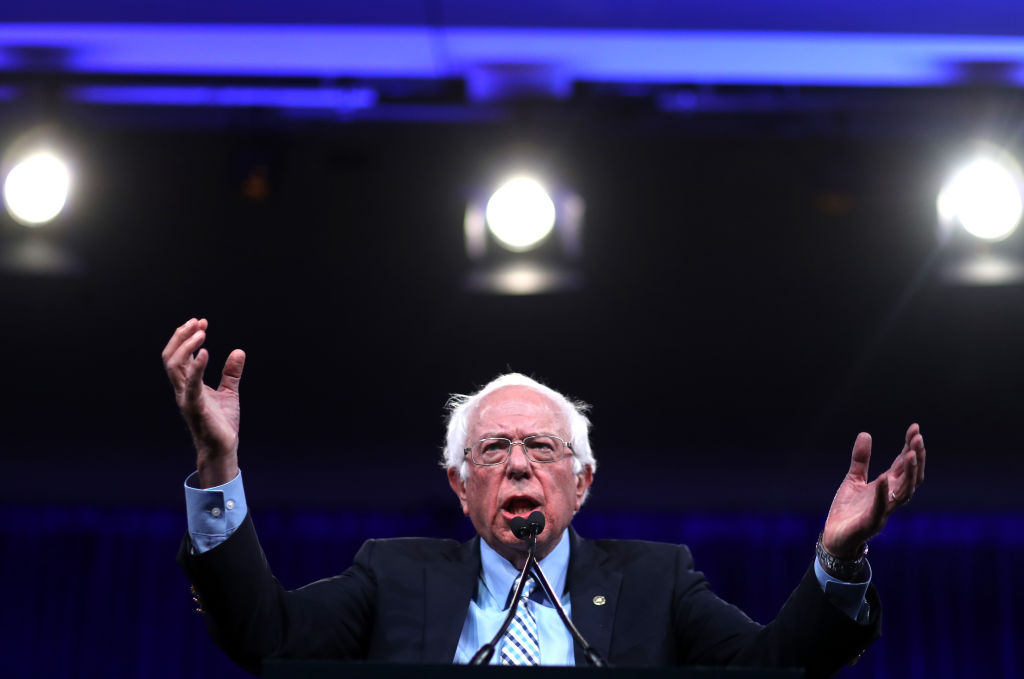
Democratic presidential candidate Sen. Bernie Sanders speaks during the Democratic Presidential Committee (DNC) summer meeting on August 23, 2019 in San Francisco, California. (Justin Sullivan / Getty Images)
The Bernie Sanders presidential campaign presents socialists with an unprecedented opening for explicitly socialist politics. And Sanders’s Workplace Democracy Plan (WDP) represents a coherent set of policies through which to pursue that opportunity. Labor scholar Barry Eidlin calls the plan the “most serious, comprehensive, and equitable plan for promoting workers’ rights ever proposed by a major US presidential candidate.” If the Sanders campaign and the WDP do represent such an opportunity, then surely socialists should use it for maximum effect. With that in mind, let’s talk about the ways that the WDP could be pushed in a more socialist and rank-and-file direction.
Let’s be honest: Sanders’s WDP is in part aimed at securing endorsements from union officials. That’s not necessarily a bad thing. Despite their reduced numbers, unions still have the ability to generate votes. Union households turned away from Hillary Clinton in 2016, helping deliver the White House to Trump. AFL-CIO president Richard Trumka has said, “We’re setting the bar high — higher than it’s ever been.” Trumka continued, “If you want our endorsement . . . show us that you’re unambiguously pro-worker and pro-union.” Securing union endorsements would represent no small step toward putting Bernie Sanders in the White House, and that would be a good thing.
At the same time, a fundamental tenet of the “rank-and-file strategy” recently adopted by the Democratic Socialists of America (DSA) is to build the “militant minority” on the shop floor, not to “permeate” the upper echelons of the union officialdom. This strategy recognizes that, although the union leaders should represent their members’ interests, bureaucratic organization and imperatives often create a divergence between the interests of leaders and “the ranks.” The fact that the WPD is pitched in part to the union leadership thus warrants examining it with a somewhat more critical eye.