The Problem With Community Land Trusts
Acquiring and administering property should not be housing movements’ only goals — advocacy for affordable housing must be coupled with bottom-up control by residents. The community land trust movement has largely abandoned fighting for and expanding that control.
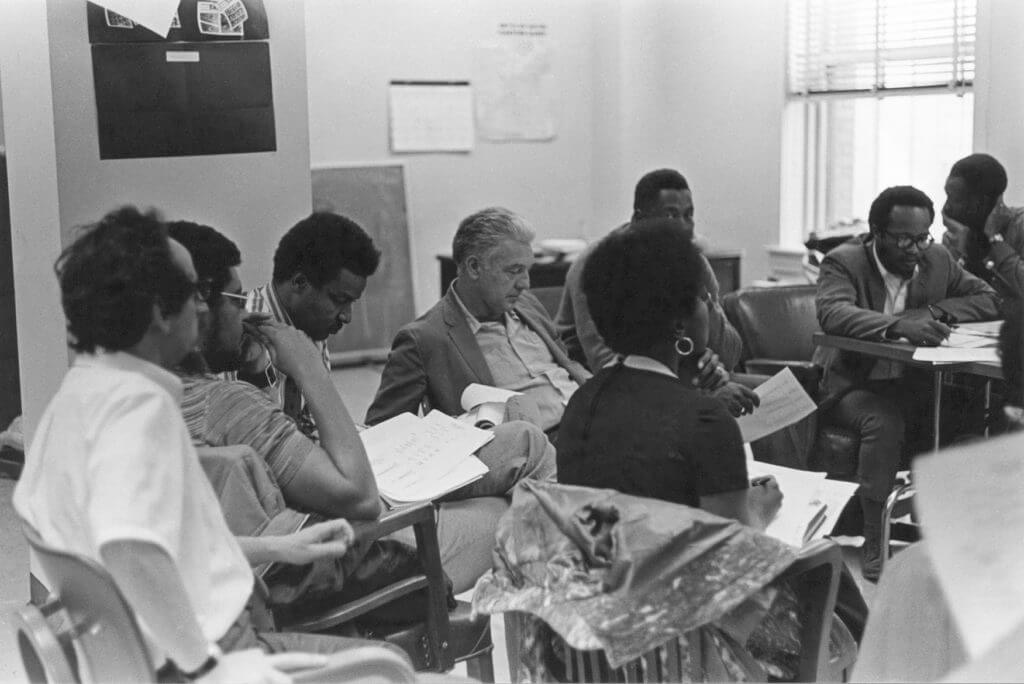
Robert Swann and Charles Sherrod with members of New Communities, Inc. at a planning meeting circa 1970. (Center for New Economics)
No progressive housing pitch today is complete without a mention of Community Land Trusts (CLTs). CLTs have become a hot topic — especially in today’s affordable housing crisis — because they decommodify land, taking it out of the speculative market so that no one can flip a house or build luxury condos on it.
The first CLT, New Communities, Inc., was designed by organizers from the Civil Rights Movement in the late 1960s as a mechanism for community control of land — especially for black communities in the rural South — in response to devastating rates of black land loss.
Then in the 1980s and 1990s, CLTs emerged in cities, where they proved useful both in reducing blight and providing stability in disinvested neighborhoods.