Giving Amazon’s Side of the Story
The New York Times recently profiled life on the Amazon shop floor — chaperoned by Amazon management. Perhaps not shockingly, the result was a fawning portrait of work at Amazon that only a boss could love.
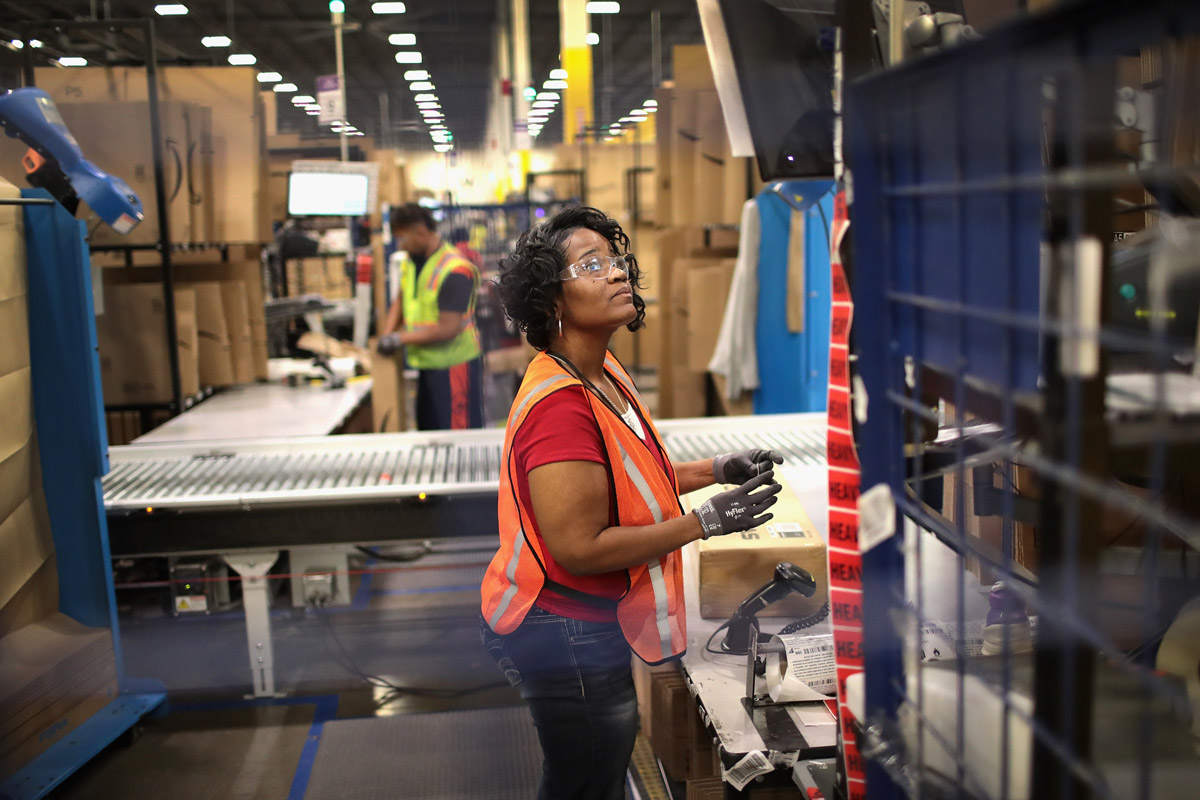
Workers pack and ship customer orders at an Amazon fulfillment center on August 1, 2017 in Romeoville, Illinois. (Scott Olson / Getty Images)
For thirty years, the New York Times’s labor reporter was Steven Greenhouse. Greenhouse was no radical, but at least he evinced a belief that workers got the short end of the stick, as epitomized by the title of his book, The Big Squeeze: Tough Times for the American Worker. On the Times labor beat before Greenhouse was William Serrin, who had come to New York from Detroit. Serrin’s most well-known book, The Company and the Union: The “Civilized Relationship” of the General Motors Corporation and the United Automobile Workers detailed how company and union collaborated to raise productivity (and wages) at the expense of workers’ demands to ease the brutality of the assembly line.
Factories could be humanized, Serrin opined. But to want to do so would require believing that the men and women who worked there were not morons; they were capable of reimagining their work in a more fulfilling and less brutal way, and deserved to be able to do so. Serrin did not think they were morons, and he felt for their abuse on the job.
Serrin died last year, and right about now he must be rolling over in his grave. That’s because the Times’s current labor journalist, Noam Sheiber, thought that the best way to find out what it was like to work at one of the most important companies in the world today, Amazon, was to accept a chaperoned tour through their Staten Island fulfillment center: “in mid-May, I spent a few hours observing workers and asking them about their jobs, with a press chaperone in tow. By the end, I had concluded that both sides had a point.”