When Nobody Can “Take Back Control”
With the emergence of the centrist Independent Group, British politics is in a state of near collapse — and the democratic deficiencies of the country's politics have been exposed.
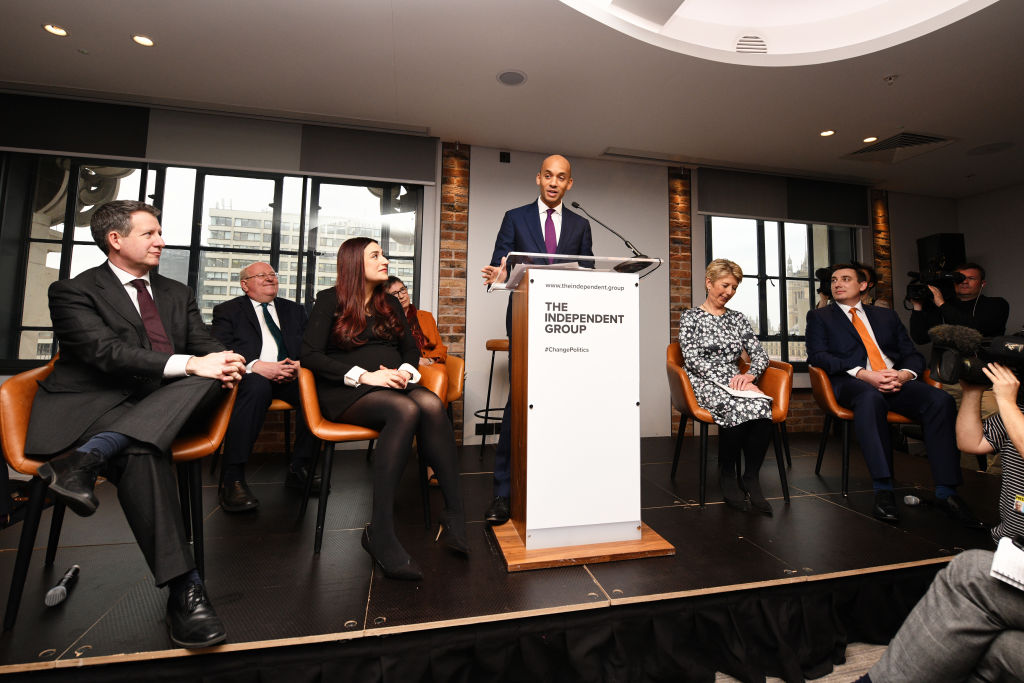
Labour MP Chuka Umunna announces his resignation from the party at a press conference on February 18, 2019 in London. Leon Neal / Getty
The breakaway Independent Group has existed for close to a fortnight now, with little sign of the obsessive media coverage of their every move (including a trip to a chicken restaurant) abating. Initial discussions over whether members of the group would call by-elections in their respective constituencies have also fallen by the wayside, for a simple reason: there is nothing in electoral law that forces them to do so. Labour has begun the process of selecting candidates in the constituencies their members defected from, and been criticized for doing so, as well as for campaigning in ex-Tory Anna Soubry’s seat of Broxtowe.
The criticism leveled at Labour, especially for the latter, is a baffling phenomenon, but a standard example of the British media’s ambivalent relationship to logic. Broxtowe is typically a marginal seat and remains so. Soubry is not a Labour MP, and has publicly stated that both she and other Independent Group MPs will do nothing to bring down the present Conservative government. But the media preoccupation with the Independent Group, the sensible face of centrism, leads to ludicrous depictions of the decision to contest Broxtowe as a campaign of personal abuse targeting Soubry. First Labour is accused of not understanding how campaigning works, then when it campaigns to win marginal constituencies, thus increasing its seats in the House of Commons, it is accused of borderline misogynist abuse.
But the defecting MPs’ refusal to move to a by-election highlights one of the biggest problems in UK politics: a complete lack of accountability outside of the ballot box. None of the eleven ex-Labour and Tory MPs has any idea whether their constituents would have voted for them knowing they’d abandoned the party they stood for, and from which they received funding and campaigners. Polling found only 6 percent of Labour voters cast their ballot because of their local candidate or MP: the party’s manifesto was a far bigger draw. The hardcore Chuka Umunna fans simply weren’t there. Yet when a successful office-seeker abandons the party, little can be done to shift them until the next election.