Workers Are Striking Again
New figures show that the strike is back: 485,000 workers participated in major work stoppages last year, the most in decades. Labor has to use that momentum to fight for the entire working class.
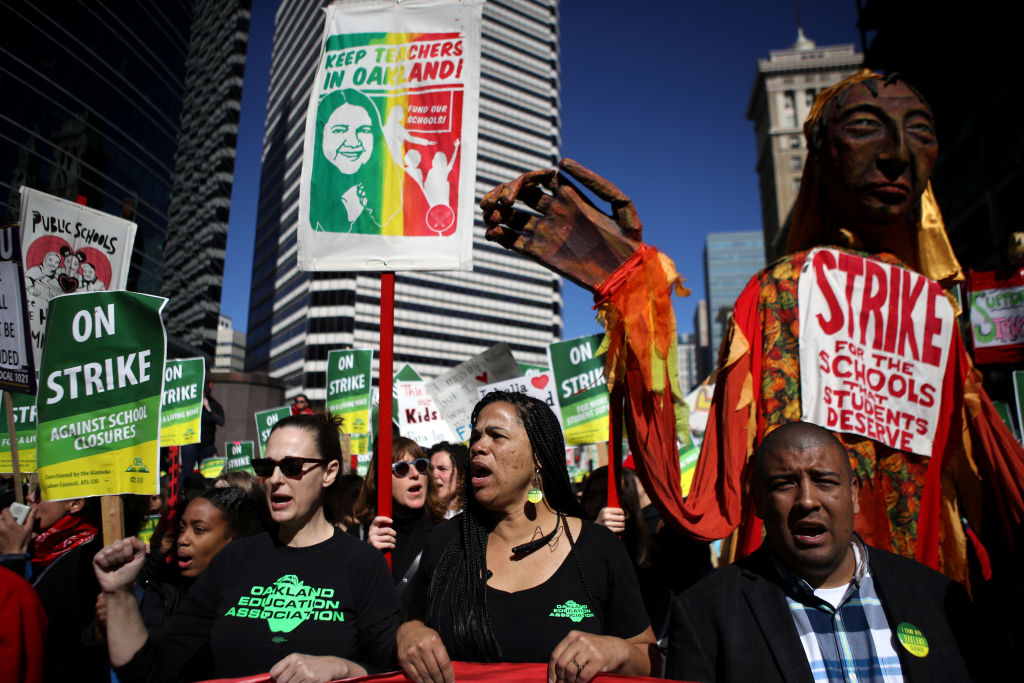
Oakland Unified School District students, teachers, and parents carry signs as they march to the Oakland Unified School District headquarters on February 21, 2019 in Oakland, California. Justin Sullivan / Getty
The Bureau of Labor Statistics (BLS) released its summary of strike activity for 2018 earlier this month, and the numbers confirm that the decades-long one-sided class war has given way to a two-sided battle. 2017 saw a depressingly low count of 25,000 workers striking in major work stoppages; 2018’s total topped 485,000.
The new numbers arrive just two weeks after another BLS report showing that labor density continued to decline in 2018. Coming in the wake of the Janus Supreme Court decision, the decline in membership is not particularly surprising. But that decline in official union membership is happening at the same time as an uptick in on-the-job militancy.
Before the strike numbers were released, Doug Henwood sorted through some of the union membership numbers, noting that while the numbers were down, the decline isn’t the bloodletting that many the mainstream commentators predicted in the wake of Janus, at least not yet. Though labor is starting from a weak position, the key measure of labors strength — strikes — is on the rebound in a major way.