What It Means to Be a Marxist
We can only change the world if we understand the actual forces around us. Marxism gives us the tools to do just that.
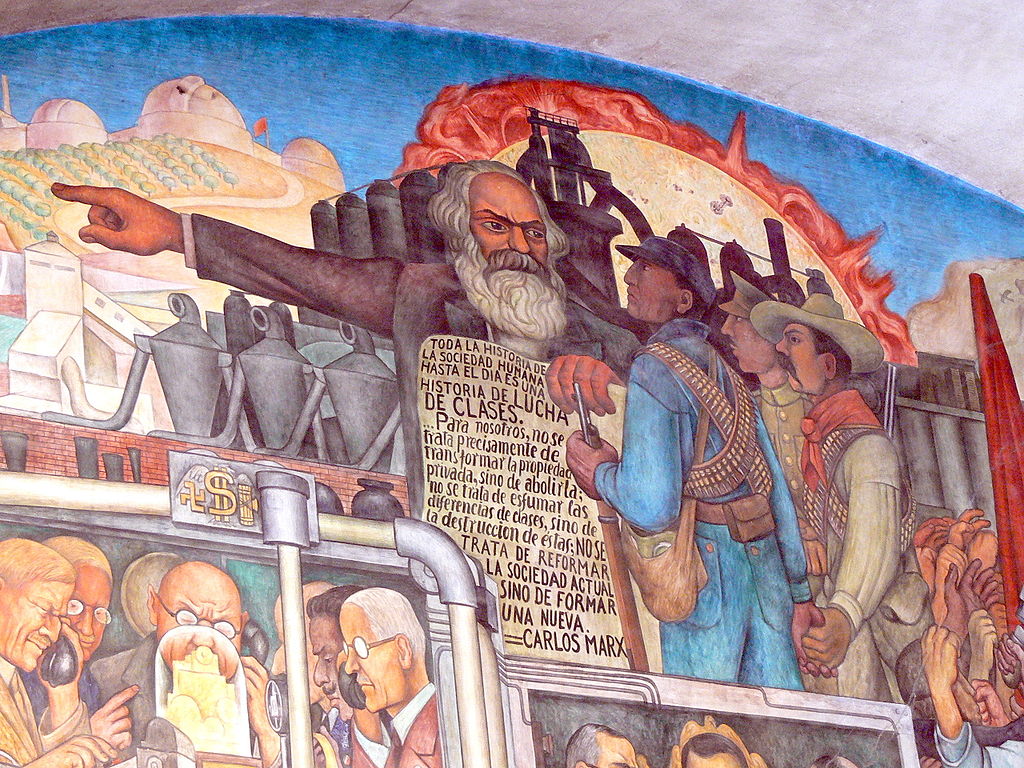
Mural by Diego Rivera showing the history of mexico, detail showing Karl Marx, Mexico City, Palacio Nacional, 2008.Wolfgang Sauber / Wikimedia
It’s unfortunate that there isn’t a better word for “Marxism.” Marx himself famously once said that he himself was “not a Marxist” if certain askew interpretations of his theories of historical materialism and capitalism were “Marxist.” Part of the problem is that the theories and processes that Marx helped create are too big to fall under a single -ism; Marx was a philosopher (and sort of historian) of political economy, that is, the study of production and trade in relationship to laws, customs, and human systems, whose theories helped inform numerous other disciplines and practices: economics, sociology, history, literature, and practical politics, among others.
The closest analogy that I can think of is to what we would today call “Darwinism,” the theories of nineteenth-century biologist Charles Darwin. Darwin didn’t invent biology, paleontology, genetics, or any of the numerous disciplines and practices that are informed by “Darwinism.” And in fact, there are many aspects of classical “Darwinism” — the theories and conclusions arrived at by Darwin and his immediate disciples — that have been outright revised or rejected by people who today would still consider themselves “Darwinists.” Since Darwin published On the Origin of Species and The Descent of Man, hundreds if not thousands of scientists and philosophers have expanded on and improved Darwin’s theories (the so-called “modern synthesis”) — obviously a necessity since during Darwin’s lifetime there was no deep concept of molecular genetics.
It’s useful to think of Marxism the same way. Marxism is not a detailed plan for how to create socialism. Marxism isn’t a moral philosophy, in the way that the Enlightenment philosophers and their progeny — like John Rawls — tried to build up moral systems from first principles to determine what is the most “fair.” It does not instruct us to engage in violent insurrection.