What Is a Jacob Rees-Mogg?
Behind the façade of the bumbling upper-class twit, Britain’s right-wing tribune is playing a canny long game. His goal: injecting far-right ideas into the mainstream.
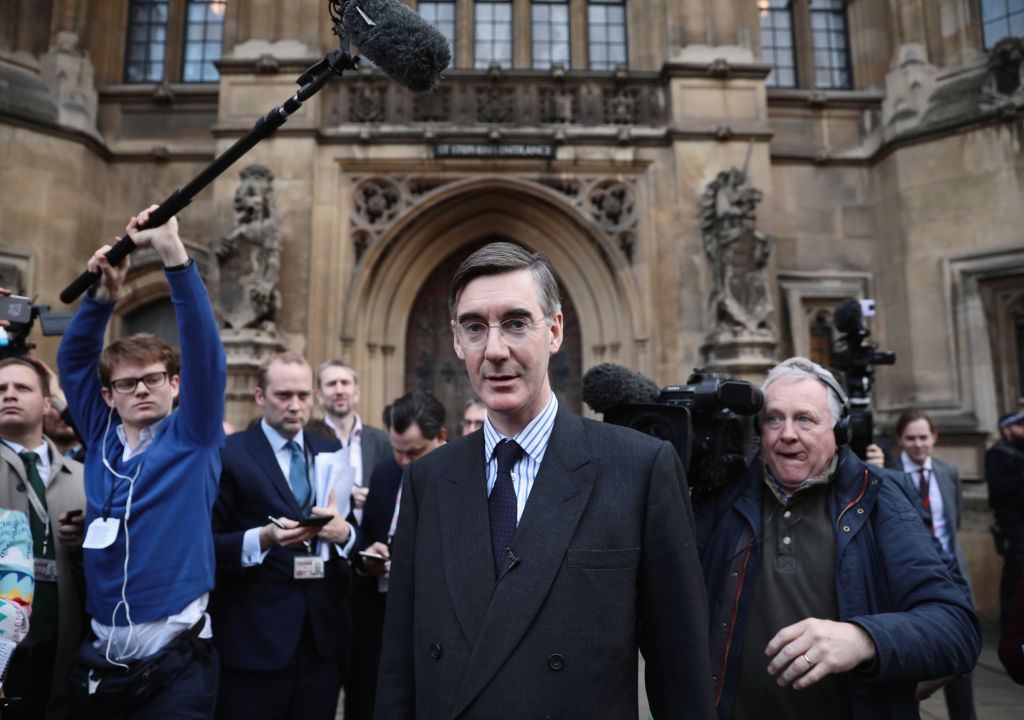
Jacob Rees-Mogg speaks to the media after submitting a letter of no confidence in British prime minister Teresa May outside the Palace of Westminster on November 15 in London. Dan Kitwood / Getty
What purpose does Jacob Rees-Mogg serve? The forty-nine-year old member of Parliament, a former hedge fund manager worth over £100 million, was once a relatively low-profile figure on the Conservative benches. Finally elected in 2010 after several failed attempts to win a parliamentary seat, Rees-Mogg symbolized a Conservative party that remained out of touch with the masses — an image the party was desperate to throw off. By Rees-Mogg’s own admission, merely opening his mouth lost him votes: generations of extreme wealth and privilege are symbolically bound up in the accent he remains proud of, but most voters find such elitism a turn-off. Campaigning in Scotland in a safe Labour seat in 1997, he attracted ridicule in working-class Central Fife for bringing along his nanny at the age of twenty-six, and arriving in a Mercedes. Shortly afterwards, he said of the Northern and working-class Labour deputy prime minister, “John Prescott‘s accent certainly stereotypes him as an oaf.”
Rees-Mogg’s background is comically elitist: the son of a former Times editor, William Rees-Mogg, he attended the private boarding school Eton, then studied history at Oxford. Rees-Mogg the Younger is fully aware of the class privilege he exudes; indeed, he emphasizes and plays it up: opting for anachronistic outfits, an Instagram account stuffed with photographs of himself in double-breasted suits, or his young children dancing on a Union Jack rug. In parliament and in media interviews, Rees-Mogg appears to have been invented purely to act as a living example of pleonasm: his speeches and remarks are long-winded and reliant on stuffy, antiquated and obscure vocabulary, deliberately obfuscating meaning in an attempt to appear more intelligent than his opponent.
What could such a relic then bring to the Conservative party? Like Boris Johnson, Rees-Mogg is aware of the forelock-tugging tendency of many British voters to defer to their social superiors. Many bridle at accents and behaviors like those of Johnson and Rees-Mogg, but many more still perceive them as intelligent and well-educated men by virtue of their educational history, class, and appearance. Both have been touted as possible leaders of the Conservative party if Theresa May is ousted in the immediate aftermath of the Brexit withdrawal. But neither man expects to become prime minister or Conservative leader. Their roles are different — both work to launder messages and perspectives from the far right, pulling them into the mainstream of Conservative thinking.