El Chapo and the Narco-Spectacle
El Chapo's trial continues this week, brimming with sordid tales of kingpins and cartels. But what the media spectacle can't justify is a failing “war on drugs” that has taken the lives of hundreds of thousands of people.
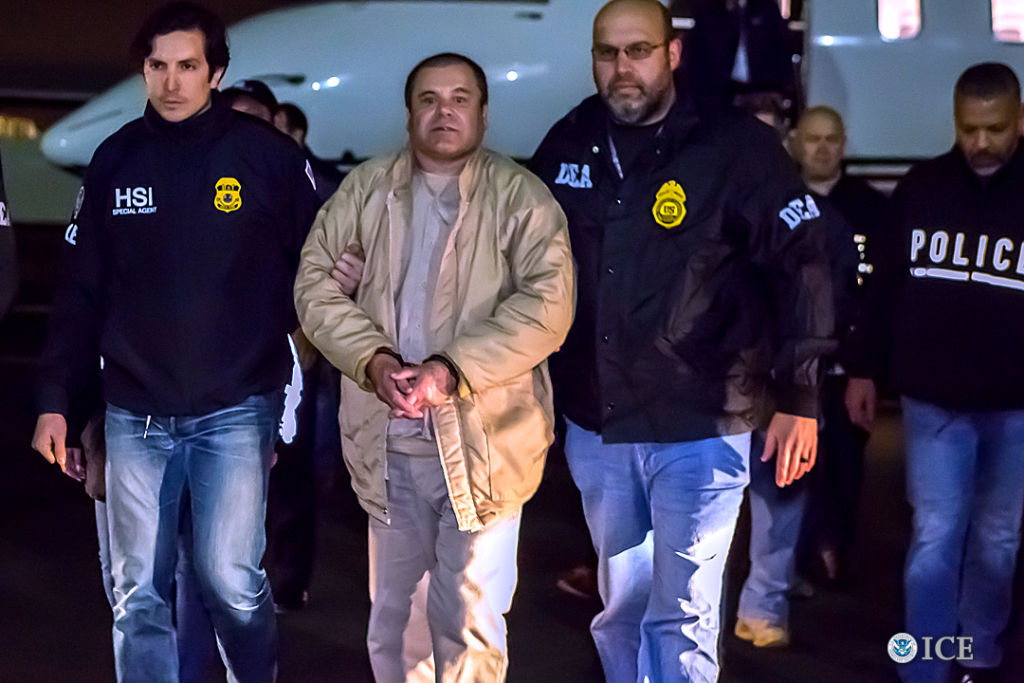
Joaquín “El Chapo” Guzmán arrives in New York under heavy escort on January 19, 2017. Charles Reed / US Immigration and Customs Enforcement via Getty
The ongoing trial of Joaquín “El Chapo” Guzmán, which got underway in federal court in Brooklyn two weeks ago, has brought the brutal contours of the Mexican drug war to the center of US media attention. El Chapo, the world’s most infamous drug lord, has long run the Sinaloa drug trafficking organization (still the largest such organization in Mexico), with his partner, Ismael “El Mayo” Zambada, who remains at large. Prosecutors are relying on a number of witnesses they have flipped within the Sinaloa organization, including Jesús “El Rey” Zambada, brother to El Mayo, who was arrested in 2008 and is now the US government’s star witness. Over the course of last week, Zambada testified to a staggering level of violence and corruption, revealing millions of dollars in bribes and dozens of killings.
But while these revelations mean that the US media will briefly turn its titillated gaze toward the havoc that US drug habits have wreaked in Latin America, the trial of El Chapo is not intended to reveal the truth about the so-called “war on drugs.” Just the opposite. It’s a last-gasp effort to salvage the reputation of a failing war that has cost hundreds of thousands of lives — a war that has been justified through a series of dissimulations, half-truths, and outright lies about how drugs are trafficked, why violence has skyrocketed, and who does the “organizing” of organized crime.
Once “El Rey” Zambada began his testimony, laying out his work moving drugs and money through Mexico City, the New York Times asserted that the turncoat narco-trafficker would reveal what they called “El Chapo’s Vast Network,” and defined the Sinaloa drug cartel as “an international empire with a top-down structure of leaders, sub-leaders and ground-level workers.” While Sinaloa had once been a disorganized, ragtag group of comrades and kin, it was now, the Times reported, a “sprawling drug conspiracy” under the direction of a “Mexican kingpin.”