US Workers Are Striking Again
Halfway through the year, the number of large strikes in the United States is at the highest level in decades.
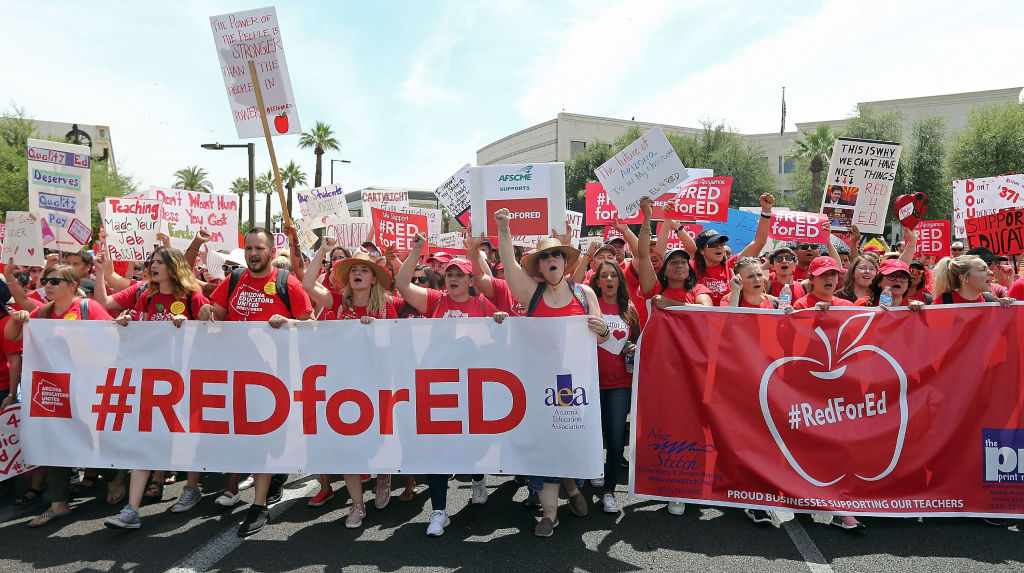
Arizona teachers march through downtown Phoenix on their way to the State Capitol as part of a rally for the #REDforED movement on April 26, 2018 in Phoenix, Arizona.Ralph Freso / Getty
In the 1980s there was a phrase used to describe the increasing unwillingness of US labor unions to go on strike. In the disastrous 1981 air traffic controllers’ strike, over ten thousand members of the Professional Air Traffic Controllers Association (PATCO) were fired by President Reagan. That was seen as the beginning of a rougher era of union-busting and increasingly adversarial labor relations, and large strikes in the US fell in the following years. The phrase “PATCO Syndrome” came to describe the fear of striking and losing.
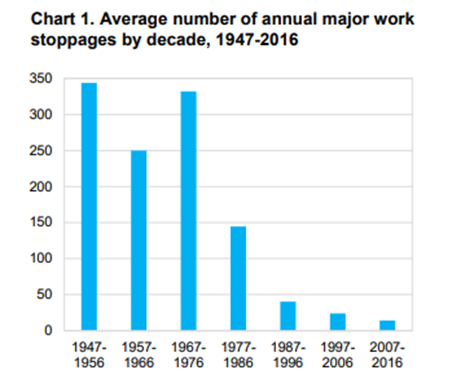
In reality, US labor relations have never been cordial and large strikes have been declining since the 1970s. The Bureau of Labor Statistics (BLS) releases a report early every year of the number of large work stoppages the previous year. BLS defines large work stoppages as “involving 1,000 or more workers lasting one full shift or longer.” In counting work stoppages, it includes strikes and lockouts (where the employer refuses to let the union members work), but the list is usually mostly strikes. In 2017, BLS released this stunning chart summarizing seventy years of collecting this data.