Striking on Other People’s Behalf
Shutting down ports, roads, and railways has long been a key weapon of French labor. But overreliance on small groups of workers in “strategic industries” can also demobilize broader social movements.
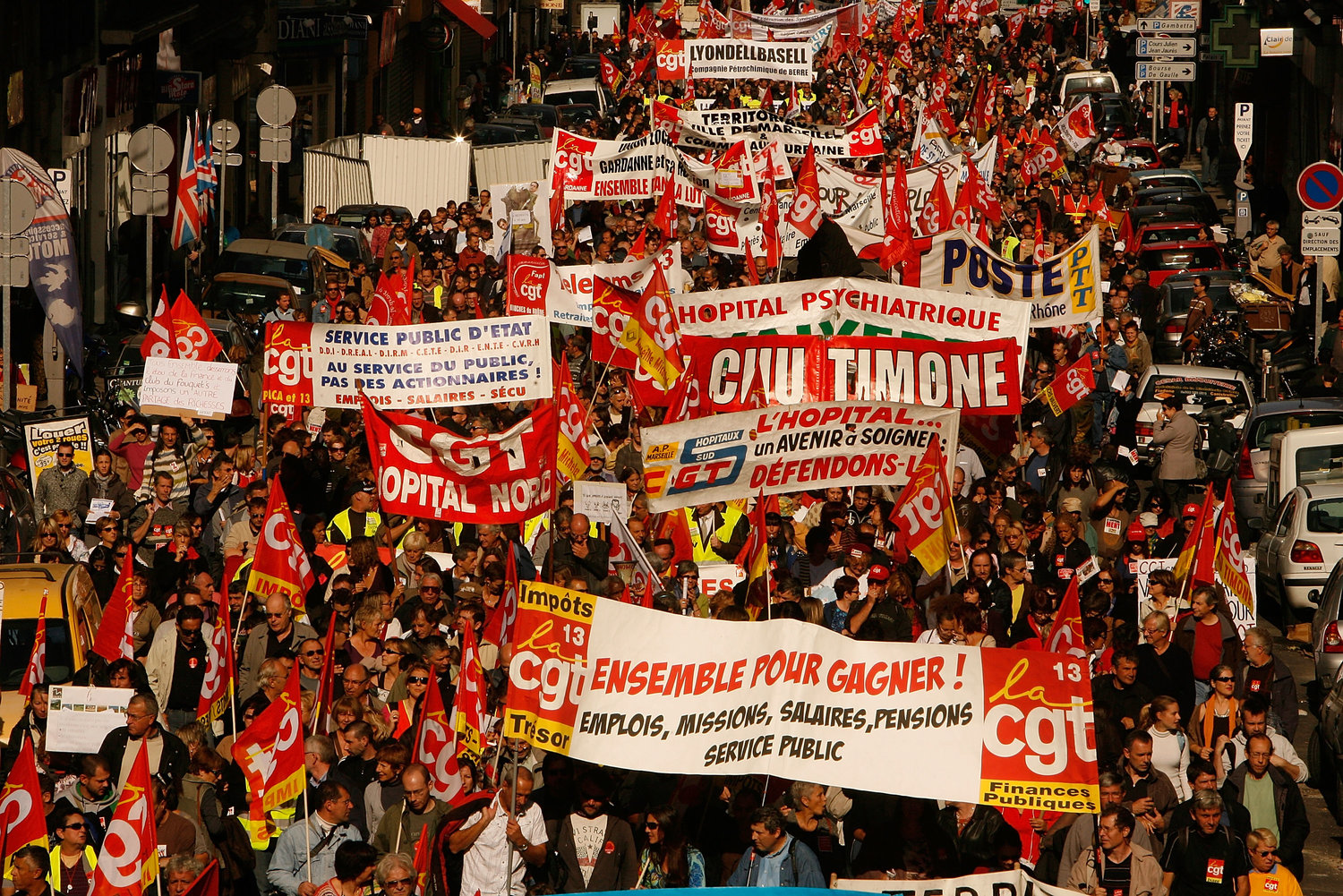
Tens of thousands of French workers protest as the unions in France strike against a pension reform plan on October 28, 2010 in Marseille, France. Patrick Aventurier / Getty
In spring 2016, mass strikes in France’s second-largest port city brought the local economy to a halt. Le Havre, a city of 170,000 people, was at the forefront of the nationwide struggle against neoliberal labor law reforms designed to undermine workers’ job stability. As local press dubbed Le Havre the “capital of the mobilization,” journalists flocked from Paris to take a closer look. A reporter from right-wing daily Le Figaro described a city paralyzed by “a handful of radicalised strikers.” He noted with alarm that “The port of Le Havre . . . has reached a standstill like Pompeii.”
This comparison with the Italian city buried under volcanic ash in 79 AD was doubtless an exaggeration. But if the same journalist returned to Le Havre in late 2017, as Emmanuel Macron imposed his own neoliberal Labour Code, he could hardly write the same. Faced with fresh government attacks on labor, the port city was anything but paralyzed: locals walked the streets like normal and giant vessels calmly pulled into the docks. There were multiple days of action, but nothing on the scale of 2016.
This was not because new president Emmanuel Macron’s Labour Code was any less brutal than previous ones: in fact, under his government, the neoliberal logic of attacks on workers’ compensation and the unions has reached fresh heights. Nor does this shift owe to any change in the character of Le Havre itself. An old “workers’ fortress,” governed by Communist mayors from 1965 to 1995, this “rebel city” is still a center of trade unionism: the biggest union federation, the CGT, has membership rates over triple its national average.