Hanging Over the Edge
The Genoa bridge collapse in Italy is an absolute disaster. It's also the result of privatization and austerity.
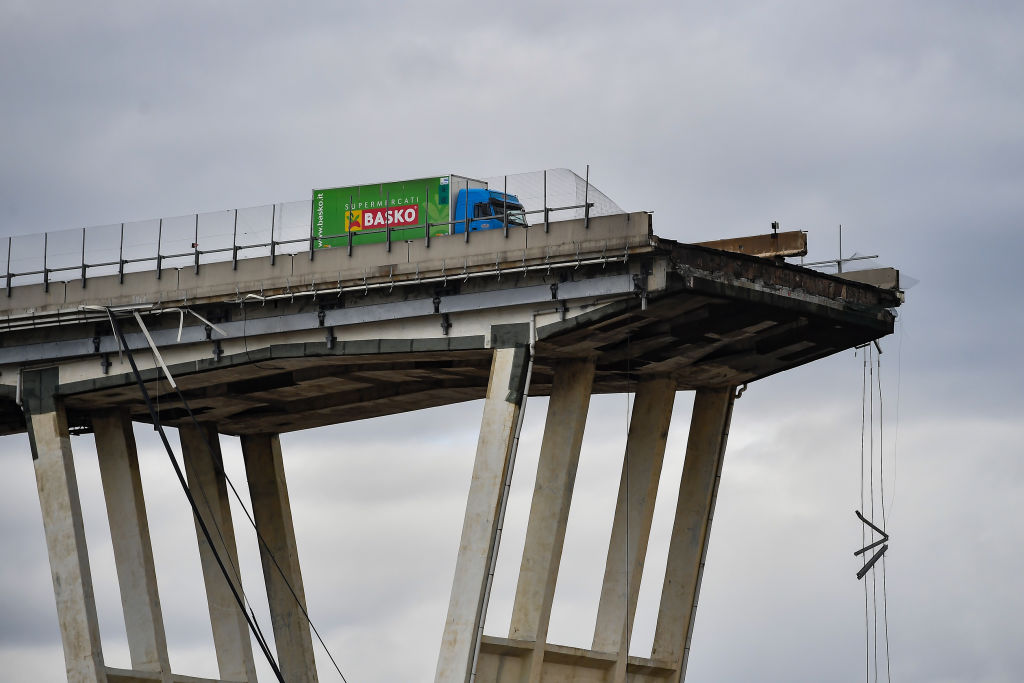
A view of the Morandi bridge, which collapsed on Tuesday in Genoa, Italy. Paolo Rattini / Getty
On Wednesday, the day after the collapse of Genoa’s Ponte Morandi killed thirty-nine people, a civil engineer told la Repubblica that three hundred other bridges and tunnels around Italy are in a similarly extreme state of disrepair. Tellingly, this “engineer M.” spoke to the newspaper on the condition of anonymity, in order to avoid offending the unscrupulous private interests hired to maintain Italy’s thoroughfares. The collapse of the motorway bridge is the latest and worst of a string of fatalities caused by roads and railways that no one bothers to keep in proper condition.
Before Tuesday’s disaster, five Italians had already died in seven major road bridge collapses since 2013. In January, three people lost their lives when a train derailed outside Milan. In July 2016, twenty-three people were killed when two trains crashed along an outdated single-track railway in Puglia. Nor were the death tolls in earthquakes in Amatrice in 2016 (299 fatalities) and Aquila in 2009 (308 killed) mere natural disasters: investigators found that many buildings had not been adapted to earthquake proofing standards dating back to the 1970s. If this was considered “too expensive,” in the end the state ended up picking up a €20 billion reconstruction bill.
Since Tuesday, scrutiny has turned on the privatized Autostrade per l’Italia, which operates the bridge. The government rushed to announce the firm would lose its concession (covering near half of Italy’s motorways), before backtracking yesterday, instead saying that this could “eventually” happen.