Ortega on Trial
The recent protests in Nicaragua began as a response to austerity reforms. They've snowballed into something much bigger.
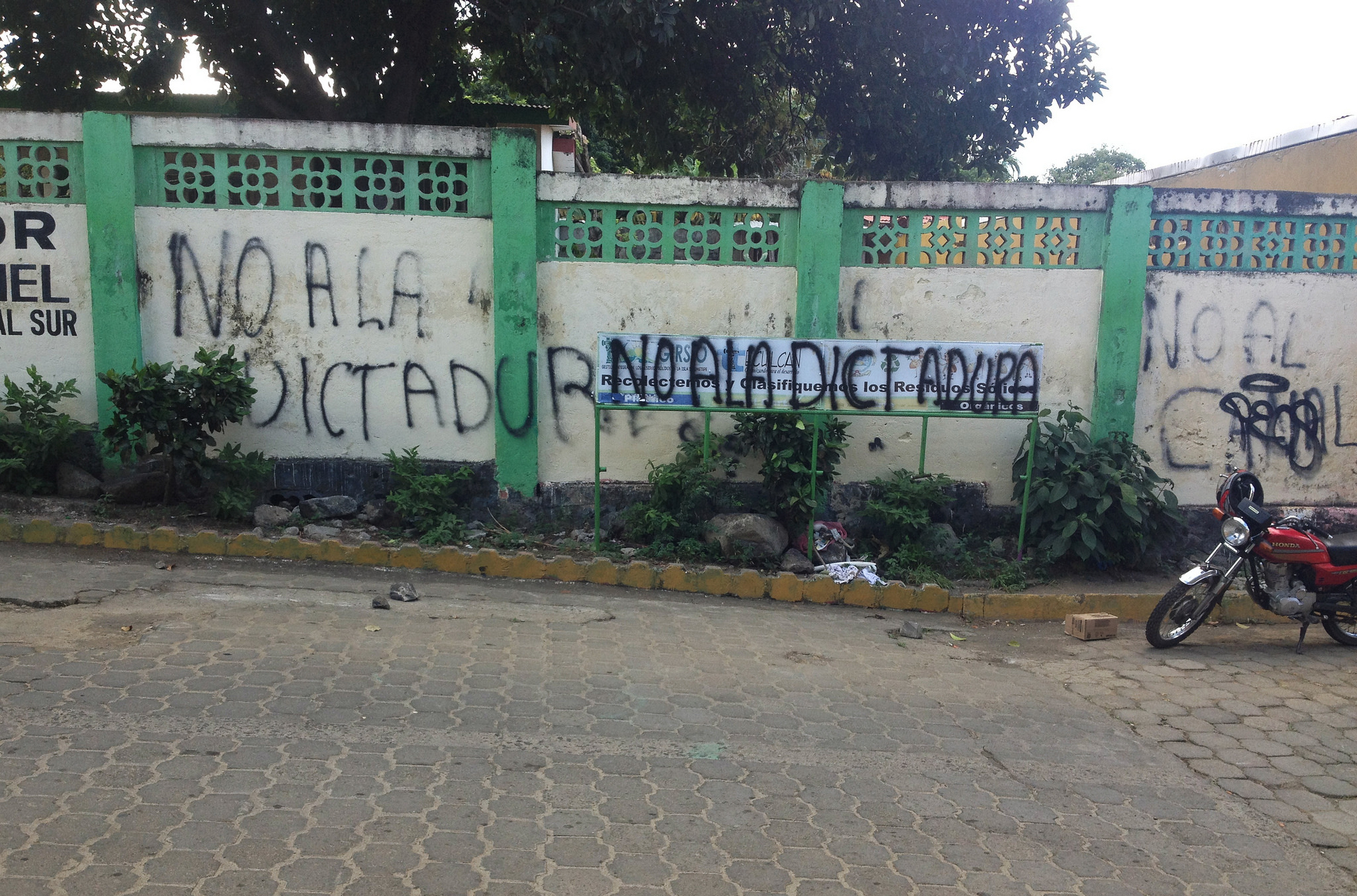
Graffiti saying “No canal, No dictatorship” on the main street in Moyogalpa, a small town on Ometepe Island, Lake Nicaragua, January 2015. ENICOK / Flickr
In recent weeks, tens of thousands of people — university students, pensioners, environmentalists, feminists, religious leaders, black and indigenous activists, journalists, as well as left-wing and right-wing opposition groups — have flooded the streets of Nicaragua, calling for the resignation of President Daniel Ortega and his wife, Vice President Rosario Murillo. The protests have shocked the world and shaken Nicaraguan politics to its core. The unfolding crisis has taken many, including the government, by surprise. Yet the conditions for this uprising have been in the making for more than a decade and reveal a deepening crisis of legitimacy for the Ortega administration.
On April 18, Ortega announced that the government, under executive order, would institute a series of reforms to the Nicaraguan Social Security Institute, which manages the nation’s pensions fund and is teetering on the brink of insolvency. The reforms would increase the amount that employees and employers have to pay into the system, while cutting benefits to elderly pensioners by 5 percent. As Jon Lee Anderson notes in the New Yorker, public response was “furious and swift, with demonstrators taking to the streets to protest” the following day. University students, many of whom had been involved in protests earlier in the month following the government’s mishandling of a wildfire in the Indio Maíz Biological Reserve on the Caribbean Coast, joined with outraged pensioners to protest the government’s actions.
The government’s reaction to the demonstrations escalated rapidly into violent repression. The state shut down multiple television stations broadcasting live coverage and ordered anti-riot police forces to disperse the demonstrations, firing live rounds into crowds of protesters while ordering the mass arrests of student activists and attacking universities in Managua. Pro-Sandinista gangs, known as turbas, and members of the Sandinista Youth also attacked demonstrators with mortars and other arms; there are reports of turbas assaulting protesters as the police stood by.