A Cure Worse Than the Disease
The “fake news” hysteria is unleashing a wave of free-speech crackdowns worldwide.
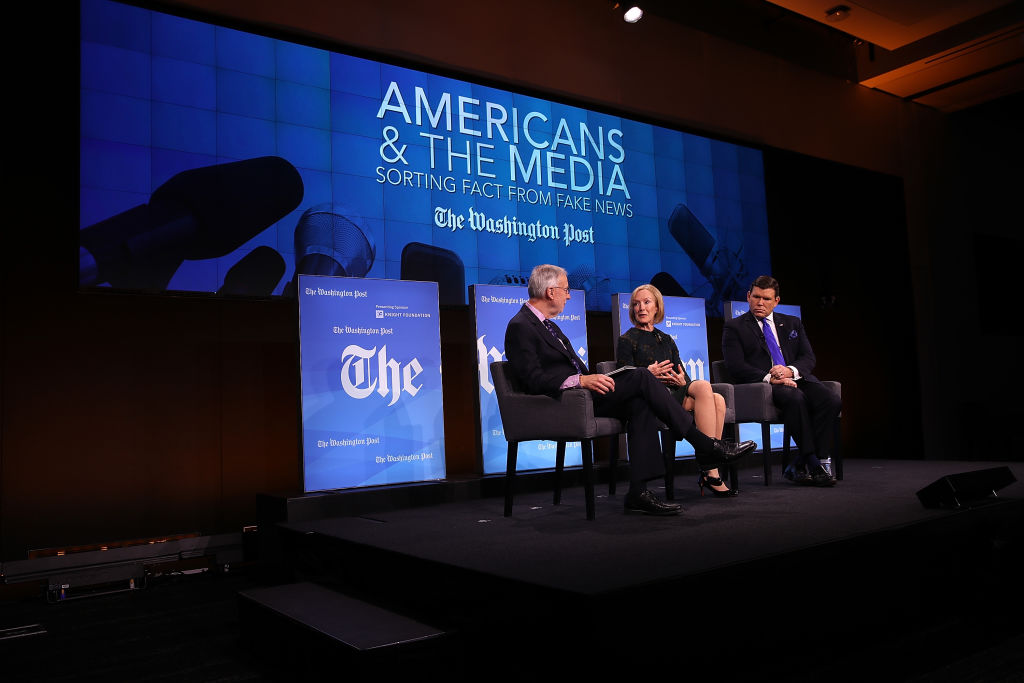
Journalists Dan Balz, Judy Woodruff, and Bret Baier participate in a discussion on “Americans and the Media: Sorting Fact from Fake News,” January 23, 2018 in Washington DC.Win McNamee / Getty
Around the world — from the West to the global south — governments are granting themselves the power to unilaterally block websites, remove content from the internet, and potentially criminalize certain topics of reporting, all with the supposed goal of putting a stop to a supposed onslaught of “fake news” that is undermining democracy. It’s an alarming development, and one that serves as a reminder of the perils of the Western world’s ongoing hyperbolizing of the threat of “fake news.” Western Europe’s three most powerful countries are now in various stages of seizing unprecedented power to censor the press. First was Germany, which last June passed the Netzwerkdurchsetzungsgesetz (Network Enforcement Act), or NetzDG for short, threatening platforms like Facebook and Twitter with fines of up to €50 million if they fail to remove certain undesirable postings flagged by users within a time frame of between twenty-four hours and seven days.
Though mainly concerned with hate speech, curbing “fake news” is a part of its stated mission (it’s in the bill’s preamble) and fear over potential Russian meddling in Germany’s September 2017 election (which never ended up happening) served as the impetus for its passage. As Heiko Maas, Germany’s former justice minister who pushed the law, said: “Anyone who tries to manipulate the political discussion with lies needs to be aware [of the consequences].”
Maas himself is a Social Democrat, which means it was actually a prominent liberal who was behind the widely criticized law. In what would turn out to be a global pattern, the law was also rushed into passage in just six months so it could be in place when Germany held its election.