Disaster Capitalism in the NHS
Years of austerity and marketization have wreaked havoc on Britain’s National Health Service. The crisis is now reaching a breaking point.
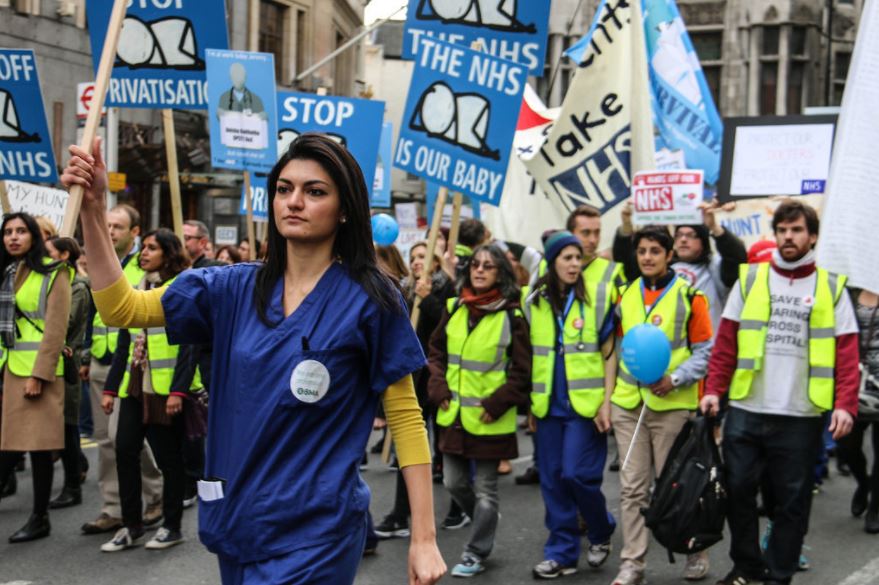
Junior doctors protesting NHS privatization on October 17, 2000. Rohin Frances / Flickr
When news of the current crisis in the English National Health Service (NHS) reached the United States, the New York Times asked its readers about their experiences with the British health system. The answers from the UK poured in via social media: “The NHS saved my sight and gave me everything I have today.” . . . “My mum had the best critical care, we never once needed to worry if we could afford it” . . . “It’s an incredible service” . . . “The best thing the UK government has ever done.”
Despite the current crisis, the British love the NHS. It’s our most popular institution, more popular even than the royal family. But it wasn’t always like this. In prewar Britain, health care was provided by a patchwork of private insurance schemes, voluntary hospitals, or by charities. I’ve heard heart-breaking stories firsthand of women dying in childbirth and children dying of preventable diseases, simply for lack of money. Illness caused major financial problems for many families, some of whom simply couldn’t afford any care at all.
In the aftermath of World War II, there was a strong feeling in the UK that, having won the war, the population was not going to lose the peace — a mood conveyed beautifully in Ken Loach’s 2013 documentary The Spirit of ‘45. When it came to health care, Britons weren’t prepared to return to the bad old ways, and the stage was set for the postwar Labour government to introduce a national health service in 1948.