Revisiting Marx’s Eighteenth Brumaire
In The Eighteenth Brumaire, Karl Marx analyzes revolution and reaction in mid-19th-century France to blistering effect. His appraisals offer enduring lessons on revolution, class dynamics, and the perpetual tussle with the bonds of history.
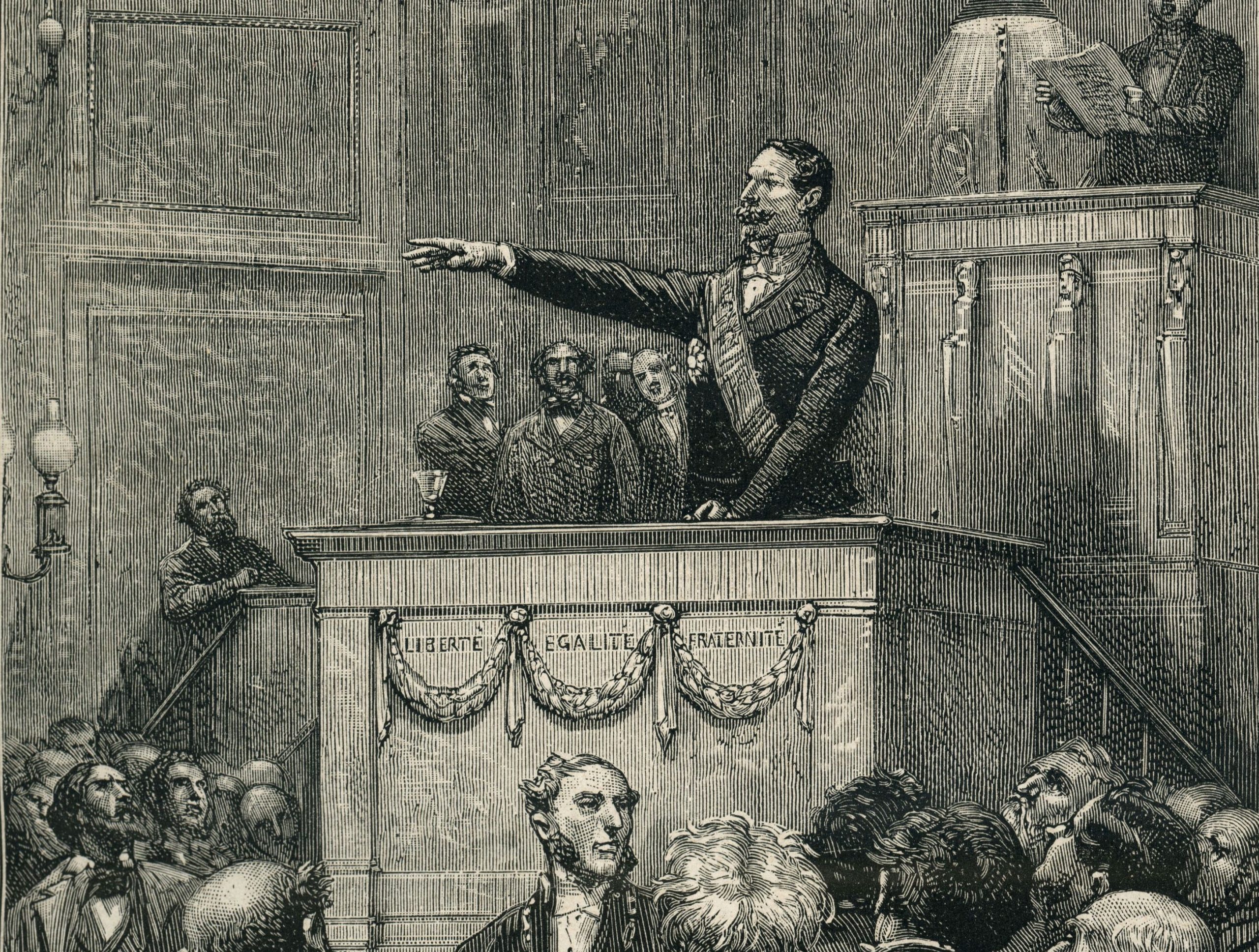
Study of an 1879 illustration, “Oath of Louis Bonaparte,” by Emile Bayard, for a printing of Victor Hugo’s 1852 Napoleon le Petit. (Pierre Pitrou / Photo12 / Universal Images Group via Getty Images)
As Marx wrote in The Eighteenth Brumaire of Louis Bonaparte, “Men make their own history, but they do not make it as they please; they do not make it under self-selected circumstances, but under circumstances existing already, given and transmitted from the past. The tradition of all dead generations weighs like a nightmare on the brains of the living.” A nightmare indeed — and one that speaks to our moment as we grapple with the weight of historical legacies.
What’s particularly striking about the present moment is how the accumulated contradictions of American political economy have reached an impasse. The old order remains in place, but it has lost its trappings of naturalness, inevitability, and permanence.
In an interview on Jacobin Radio’s podcast the Dig, Daniel Denvir talks with political sociologist Dylan Riley. They delve into Marx’s analysis in The Eighteenth Brumaire, exploring his take on revolution and reaction in mid-nineteenth century France, as well as the broader theories he develops about history. They also examine the intricate relationship between politics and the class struggle, and how Marx’s insights in the Brumaire can illuminate contemporary political dynamics in the United States.