ChatGPT Will Never Replace Thomas Friedman
No amount of technological innovation will ever hold a candle to the very special brain that is New York Times columnist Thomas Friedman’s.
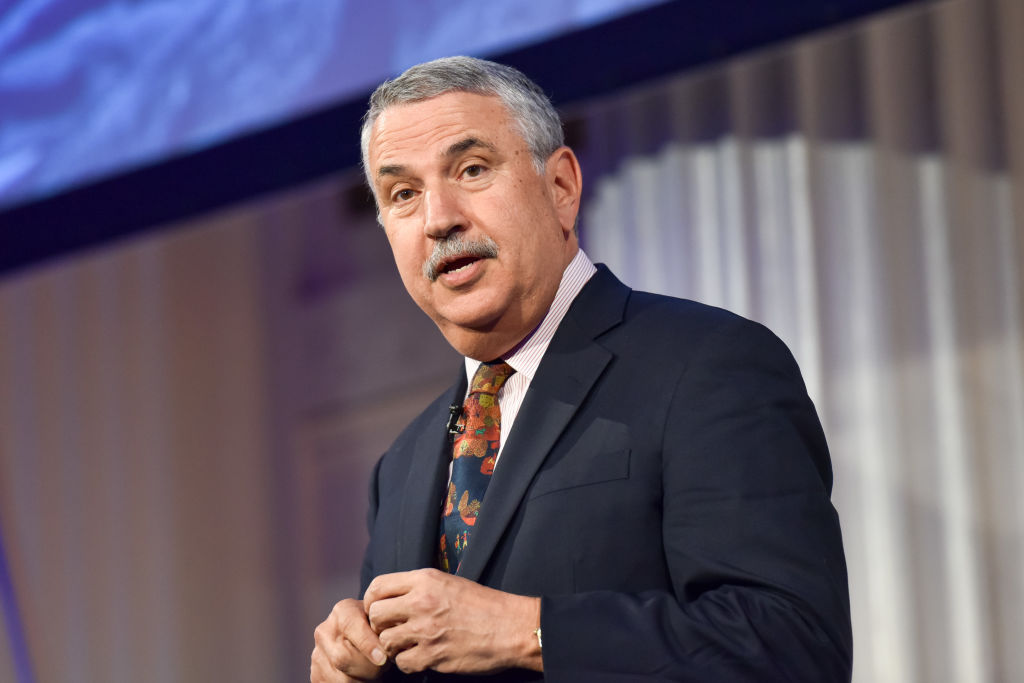
Pulitzer Prize winning New York Times columnist and bestselling author Thomas L. Friedman speaking in New York City, 2018. (Sean Zanni / Patrick McMullan via Getty Images)
Over the years, many a lesser writer has had the audacity to lampoon New York Times bestselling author and Pulitzer Prize–winner Thomas L. Friedman and his peerless prose. Like too many cooks trying to break the camel’s back, they have chuckled at his propensity for convoluted imagery and mixed metaphor. His Swiftian style has been written off as boring, repetitive, and boring. Countless more pedestrian practitioners of the op-ed form have mocked his incessant reliance on anecdote and conversations with fictionalized, salt-of-the-earth types they have never deigned to consult themselves. The same ersatz wordsmiths have somehow missed the incandescent brilliance of flourishes like: “The walls had fallen down and the Windows had opened, making the world much flatter than it had ever been — but the age of seamless global communication had not yet dawned,” which somehow manage to reinvent the laws of space and time.
These second-rate scribblers have all buttered their bread and will now have to lie in it. And, tempting as it might be to score cheap points by mocking the great man, I will not be joining in. Friedman’s March 21 op-ed proves beyond any doubt that he has attained a mastery of the craft that no other being, whether man or machine, could ever match. The opus, a sprawling free jazz riff about artificial intelligence and The Wizard of Oz, may well, in fact, be the most perfectly Friedmanesque Friedman column ever written.
Entitled “Our Promethean Moment,” a headline that reads like it was written by an algorithm asked to generate titles for hypothetical Friedman columns, the piece is a tour de force execution of the author’s signature Big Idea™: that profound, revolutionary, and vaguely defined things are occurring at an ever accelerating pace that will require transcending the old formulas — for the era of ChatGPT. Like many entries in the Friedman catalog, it begins by quoting a conversation (in this case, with Microsoft executive Craig Mundie):