The Purge Has Nothing to Say
The Purge franchise and its offshoot, The Hunt, try to feed the appetite for dark social satire about the barbaric inequalities of the modern United States. But they end up delivering little more than weak fantasies of resistance.
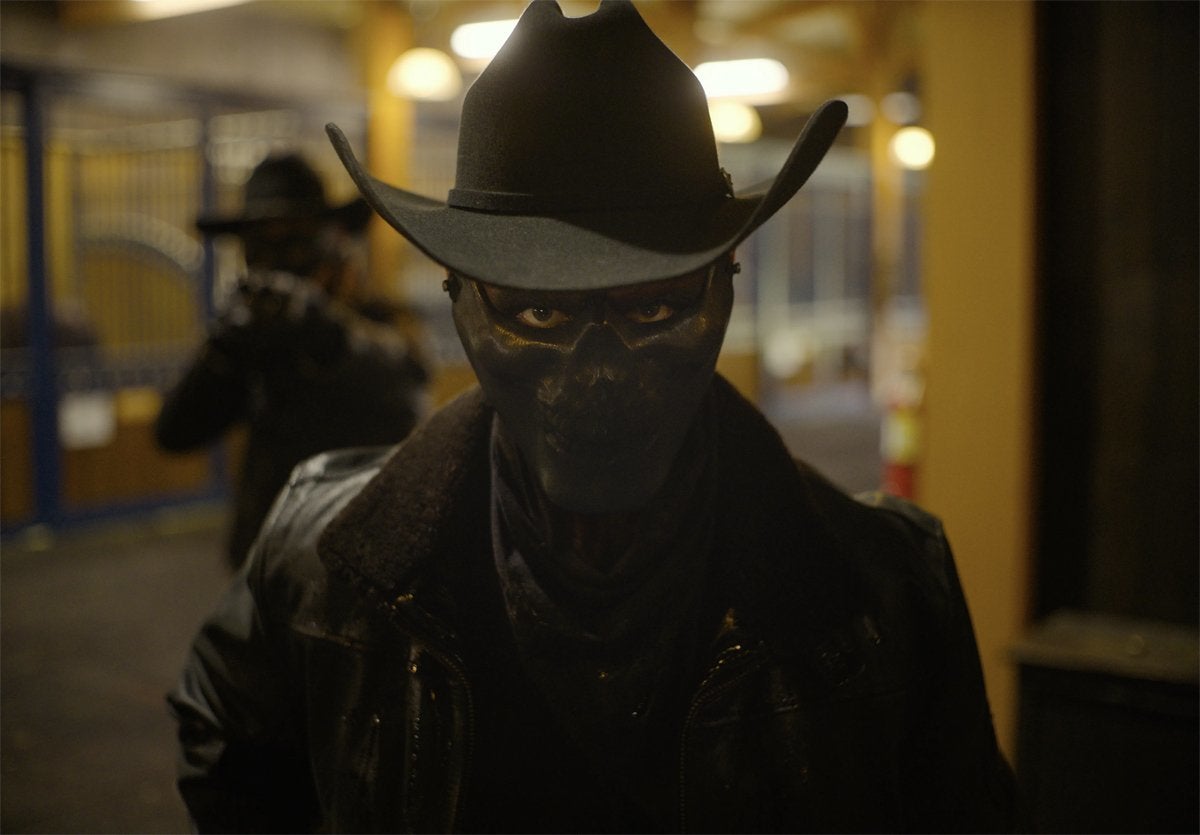
The Forever Purge tells you exactly what parallels to draw with Trump’s America. (Blumhouse Productions)
Over the past decade or so, intellectual property (IP) has become the most precious commodity in Hollywood. Within mainstream horror, a genre particularly heavy with remakes and adaptations, the mentality seems broadly to be that once you have the IP, everything else will follow. The Purge franchise has gotten impressive mileage out of this principle, taking a condensable idea loosely recycled from Shirley Jackson’s The Lottery and a 1967 episode of Star Trek — what if, for one night a year, all crime was allowed? — and spinning it into five films and a two-season TV show.
The compelling paradox of the premise is this: If crime can be made “legal,” what is it in the first place? It is one of the many questions raised and left to the sidelines in The Forever Purge, the latest instalment of the series, in which a renegade group of loyalists decide to continue the violence beyond the allotted twelve hours with the aim of “cleansing” the United States of racial minorities. We follow an unlikely grouping of wealthy and working-class citizens as the overspill of violence prompts a mass exodus of Americans into Mexico and Canada; after much fighting they make it over the border, while news reports hammer home the novelty of this role-reversed refugee crisis.
Craig Zobel’s The Hunt, released last year by the same production house and inspired by another famous short story, is also centered around elites hunting and killing people, but in this case the terrain is a culture war. In a self-consciously contemporary update of Richard Connell’s The Most Dangerous Game, we see a cabal of politically correct but bloodthirsty liberals kidnap and hunt down conservative “deplorables” who have spread conspiracy theories about them online. The former are hysterical, paranoid, obsessed with optics, while the latter are indignant, wary, and bigoted. Terms like “snowflake,” “privilege,” and “crisis actor” are thrown out from both sides and hang heavily in the air.