Amazon’s Power Will Only Keep Expanding in the Near Future
Amazon was already gargantuan before the pandemic. Its rapid growth since then has made it one of the most powerful institutions in the country’s history — shaping our physical as much as mental landscapes, and putting more and more of our daily lives under its control.
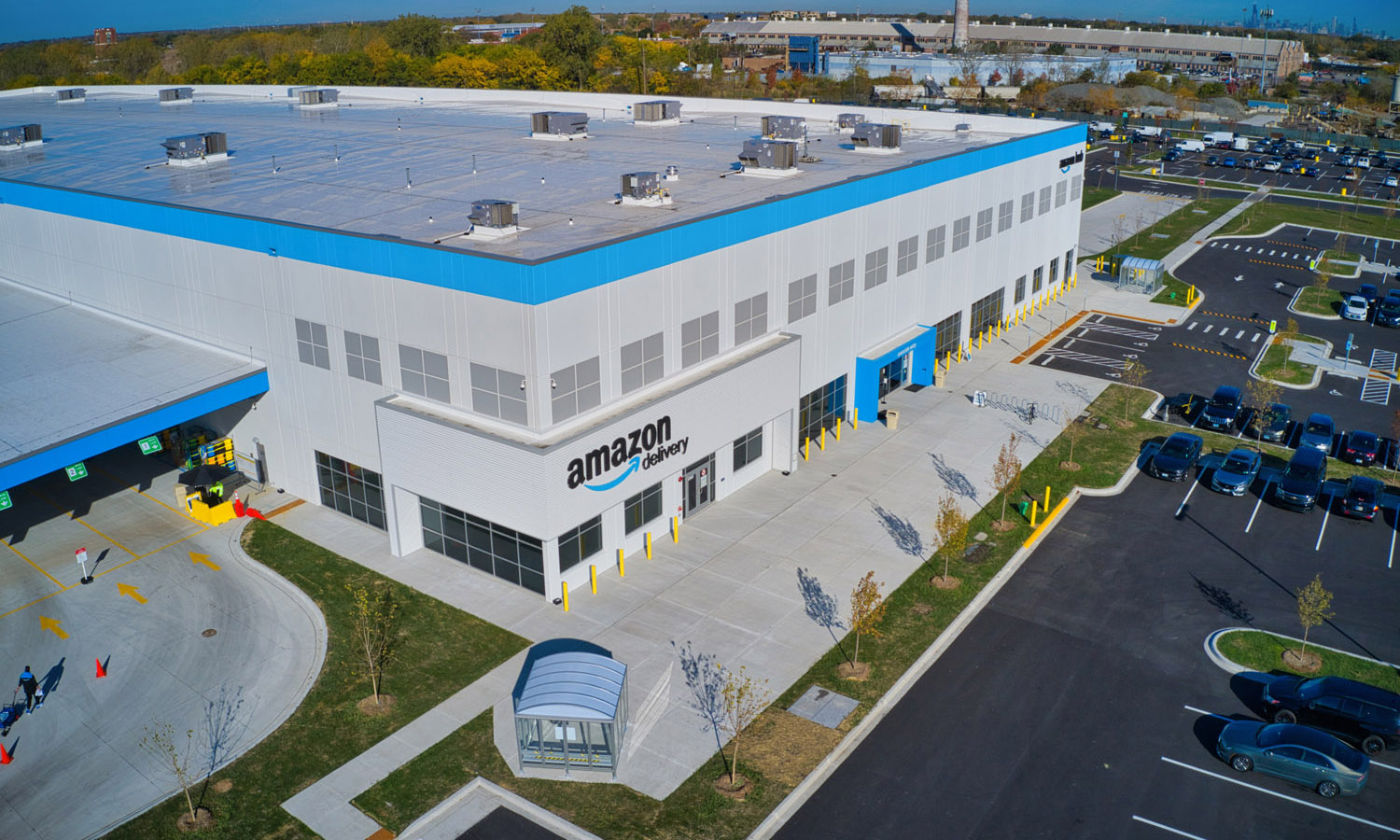
Amazon’s first Chicago delivery station, located in the city’s Pullman neighborhood.
In the wake of the union election at Amazon’s warehouse in Bessemer, Alabama, a lot of people asked how the company’s workers could have voted against unionizing. A recent article from Harper’s Magazine about the union vote in Bessemer does a lot to answer that question, painting a portrait of the anti-union campaign. The author, Daniel Brook, details how anti-union text messages, surveillance (or at least the appearance of it), and captive-audience meetings were a means of spreading misinformation and solidifying opposition to the union.
But Brook spent a lot of time talking to workers, including strongly anti-union ones, which allows him to show not only how these anti-union methods crystallize but also how broader societal trends pose obstacles to organizing, too. When worker power is as eroded as it is in the United States, it can be hard for people to imagine winning — especially winning against a company as powerful as Amazon. Brook’s article features one worker, Carrington Byers, who previously worked at McDonald’s and a nursing home. For Byers, Amazon represents mobility and support. He tells Brook, “Everybody there is family-based. Out of everywhere I’ve worked, this is the only place where my managers are helping me, guiding me through my ventures that I want to pursue outside of Amazon. This is the only place I’ve ever been where they want you to become somebody.” By contrast, Byers buys into the idea that the union, despite being a place where everyone is called “brother” or “sister,” is not a family but an extractive business.
While Byers benefits from working-class struggles, codified in all sorts of laws and norms, he hasn’t experienced proof that collective action can win better working conditions, much less a better world. He hasn’t seen it; when he looks at society, he doesn’t see proof of it there either. The article casts this as a generational division, as that is how it often played out in Bessemer. Older workers who’d either been in unions themselves or knew people who had were pro-union, whereas younger workers like Byers didn’t believe in their power or the possibilities of winning what we think of as “union benefits.” They could be convinced to oppose the union drive after weeks of Amazon telling them to stick with the company, not to mention the feeling building in the warehouse that, should workers unionize, the warehouse might shutter.