We’re Learning More About the Relationships Between Race, Class, and Police Brutality
A new paper finds that for white Americans, socioeconomic status is a major determining factor in susceptibility to fatal police violence, while for black Americans, class is critical but not decisive. The findings underscore the need to build a movement that stands against both racist police brutality and brutal class stratification.
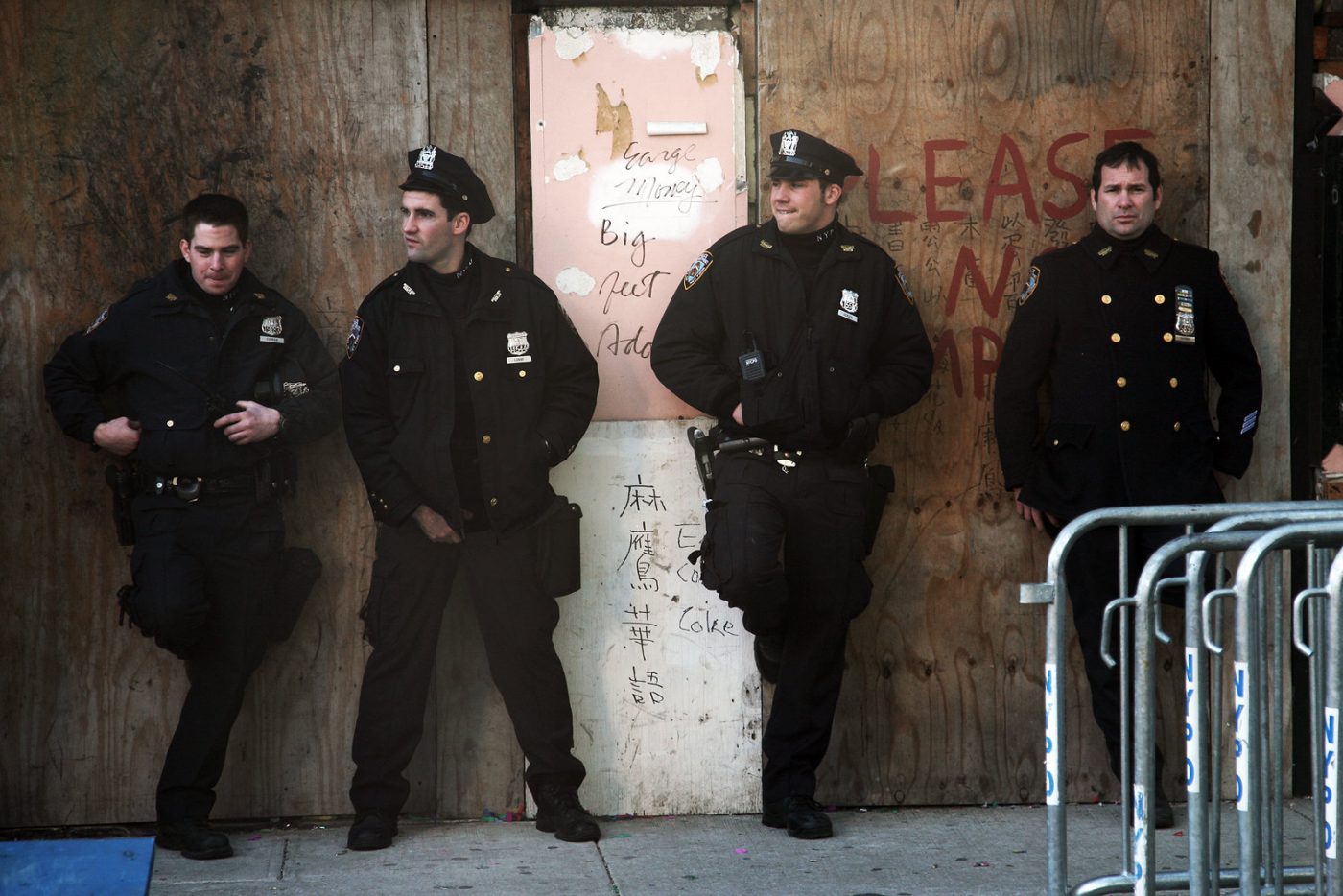
New York Police Department officers on the streets of New York City. shootingbrooklyn / Flickr
Right-wing author and commentator Heather Mac Donald’s book The War on Cops: How the New Attack on Law and Order Makes Everyone Less Safe was published in 2016, between the first and second waves of Black Lives Matter protests. In it, Mac Donald points to both crime statistics showing high reported rates of black people committing crimes and high numbers of white victims of police killings in order to argue that there is no epidemic of unjustified and disproportionate police violence against black Americans. Mac Donald denounces the Black Lives Matter movement as a “fraud” and a “dangerous distraction.”
While the Heritage Foundation, the flagship right-wing think tank, found Mac Donald’s book too extreme in places, her work has made an impression on the Right. Charlie Kirk, the founder of the right-wing youth organization Turning Point USA, acknowledged her by name this month in a shaky selfie video recorded in the driver’s seat of his car. “Was George Floyd wrongly killed? Yes. Is it a trend? No,” Kirk said. He concluded his heated monologue, “Support facts. Support data. Support our country. And support police.”
In The War On Cops, Mac Donald even takes pains to defend Darren Wilson, the Ferguson police officer who murdered Michael Brown, bemoaning the “anti-Wilson juggernaut” that couldn’t be stopped and lamenting that anti-police rhetoric will “heighten the chances of more Michael Browns attacking officers and getting shot themselves.” But her hostile stance toward victims of police violence softens conspicuously in one section. She writes: