A Democratic Virus
As the coronavirus sweeps the entire globe, democracy is becoming just another casualty.
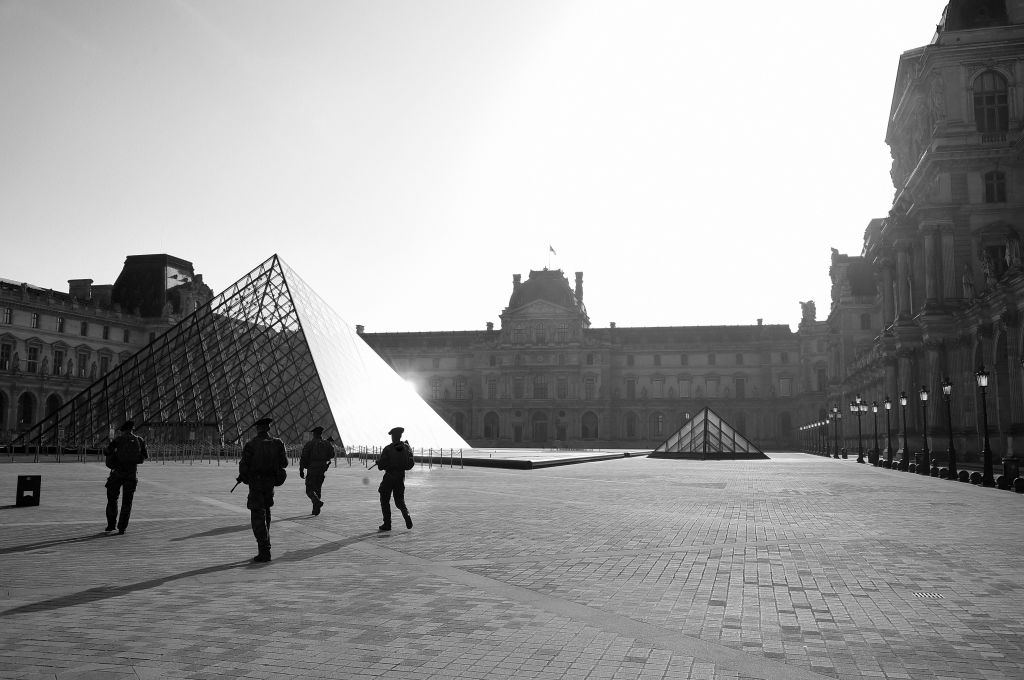
Military patrol at the empty Louvre Pyramid square on March 28 in Paris, France. (Pascal Le Segretain / Getty Images)
In the first two months of the response to coronavirus, the following happened. China imposed a full lockdown, ran a cordon sanitaire around a number of cities, removed sick family members from their homes against their will, and imposed a mandatory fourteen-day isolation. Beijing now tracks the movement of its entire population through a network of cameras, public thermometers, and personal data.
South Korea, the much-hailed model, locked down two cities, currently takes everyone’s temperature in public spaces, monitors every person’s movement through cell phone and television data, and uses government and public surveillance to keep tabs on any individual suspected of carrying coronavirus so it can enforce self-isolation. Taiwan is the same. Locals report getting a knock on the door from the police a half hour after their cell phones died because their movements could no longer be tracked.
In Hungary, Viktor Orban has postponed elections and imposed indefinite rule by decree. In Italy there is mass suspension of civil liberties — nobody is permitted outside except for government-approved purposes. Police patrol the streets and inspect whether passes follow government guidelines. France, Spain, Germany, similar. Outside Sweden and the Netherlands, there is only one other country where the central government has not ordered a mass suspension of civil liberties and has not moved in a clear and decisive way to constrain or revoke political freedom . . . the United States. The country led by Donald Trump.