The Mainstream Media’s Palace Guard
In theory, punditry is supposed to offer a forum for political analysis and debate from a range of perspectives. In practice, it’s little more than an exercise in defending the self-serving orthodoxies of a privileged few.
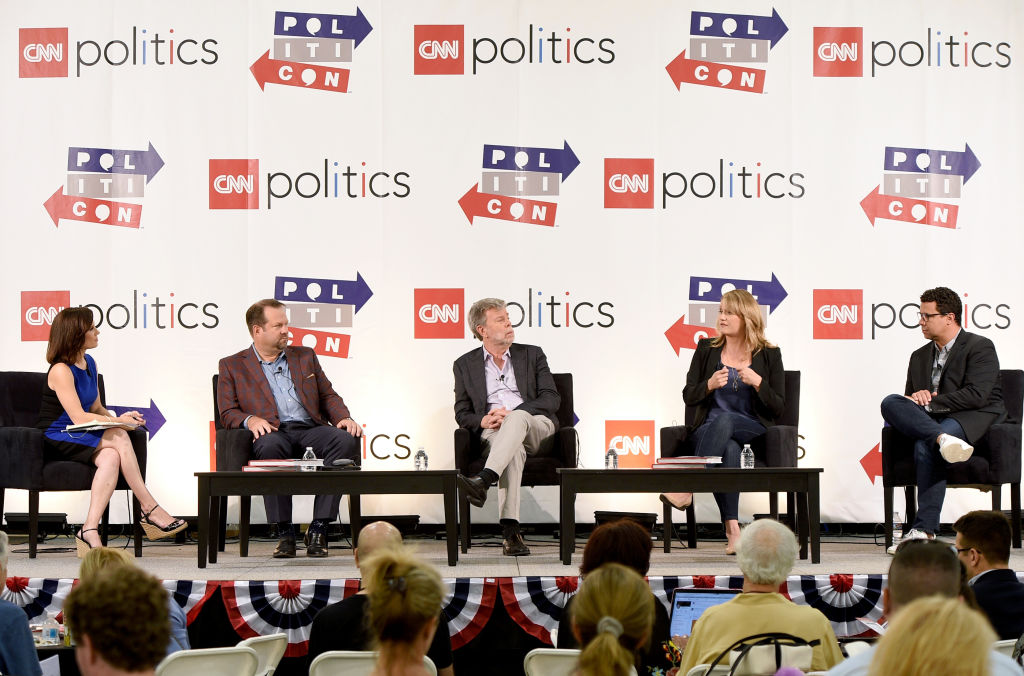
Maeve Reston, Rob Stutzman, Bill Carrick, Buffy Wicks and Bill Burton at the ‘CNN: How Democrats Can Emerge From the Wilderness’ panel during Politicon at Pasadena Convention Center on July 29, 2017 in Pasadena, California. Joshua Blanchard / Getty Images for Politicon
Last week, a video made by independent producer Matt Orfalea unexpectedly went viral thanks to its evocative juxtaposing of the elite media’s depiction of Bernie Sanders — as a perpetually angry curmudgeon and scold — with an altogether more earnest and unfiltered portrait of a politician who continues to inspire millions in spite of what regularly gets said about him on cable news and written in marquee newspapers. Its emotional resonance notwithstanding, the video’s real power comes from its radical contrast of ordinary people living in the real world with elite pundits inhabiting a very different and altogether more insular one.
Officially at least, the role of mainstream punditry — the kind of analysis that tends to be featured on major networks and in the op-ed sections of influential newspapers — is to provide commentary on the state of politics, ideally through an array of independent-minded perspectives on political news that reflect a wide range of thoughtful opinion.
Virtually anyone who’s spent time watching cable news or reading the opinion pages in major newspapers intuitively recognizes some gulf between this idealized self-image and reality, but Orfalea’s effort drives home better than anything in recent memory how much of elite punditry — an ostensibly open-minded, fact-based, and inclusive enterprise committed to intellectually curious debate — is characterized by both stupefying uniformity and breathtaking narcissism.