What Salvador Allende Feared
- David Broder
On September 11, 1973, Chile’s socialist president Salvador Allende was overthrown in a CIA-backed military coup. In this 1971 interview, published in English for the first time, Allende expressed his fears of internal destabilization and US interference.
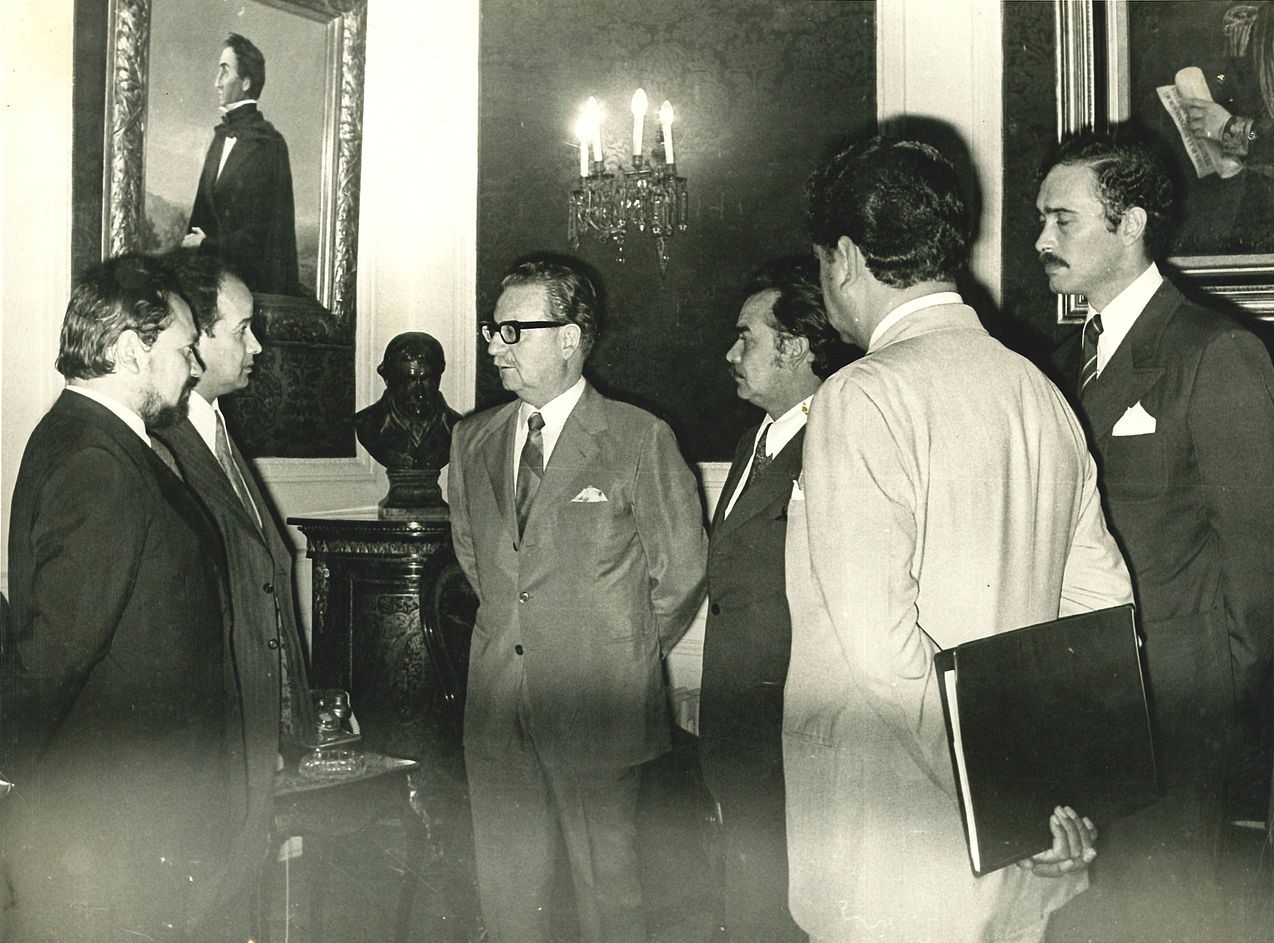
Salvador Allende with Humberto Martones in La Moneda, Santiago, Chile, date unknown.Biblioteca del Congreso Nacional de Chile
Except for certain flourishes at the election rallies, the way they talk politics in Santiago is nothing like the clichéd view of Latin America. There’s not much rhetoric, epithets are used sparingly, and there’s a notable tendency not to make exaggerated promises. Chile seems to be waiting, cautious like a cat, but certainly not a sleeping one. You can ask anyone — an intellectual, a worker, a taxi driver, or a shopgirl — why everyone is “politicized,” and no one can give you any sure answer. But that’s not because, as some love to claim, Chileans are naturally “institutionally minded” and thus placid. Rather, it’s that they know the situation’s unstable — and they aren’t hiding it. The most categorical response I got was from the greatest Chilean of all, Salvador Allende Gossens. He, like all his compatriots, measures his words, but he speaks with growing assuredness. For he has to play his cards with conviction — and in a hurry.
I spoke at length with Allende over breakfast at the presidential palace. I had been invited there together with Paul Sweezy and Michel Gutelman, whom the two Santiago universities had invited to take part in a seminar on “transitional societies.” Our presence irritated the Chilean Communists, who deserted the seminar and attacked us extraordinarily crudely in their unofficial paper . . . they called us “ignorant gringos” and “pro-Beijing” renegades. So, when the president invited us — notwithstanding his solid links with the Communist Party — it taught them quite a lesson. He knew that none of us had played down our doubts or misrepresented our positions just because of the invitation. A few minutes after we had sat down, he asked me “Is there anything in this country that you do find convincing, comrade?”
“What you’re trying to do here is important, Mr President” (and he interrupts me right away — “Not ‘Mr President,’ call me ‘comrade.’ I am a comrade just like you”). “But I think there’s a long road from here to socialism.” It’s not an answer which particularly pleases him, but he admits, “Yes, it’s a difficult road.” But he isn’t interested in dwelling on this: for him, what matters is that we understand how things move, what he wants to do, and most of all the difficulties he faces. And he has no intention of veiling them with optimism.