We Need to Reconnect Socialists to the US Labor Movement
Socialists have historically played a key role in the US labor movement as part of a broader current of militant rank-and-file workers. The recent teachers’ strike wave shows that to rebuild unions, we have to build that militant current.
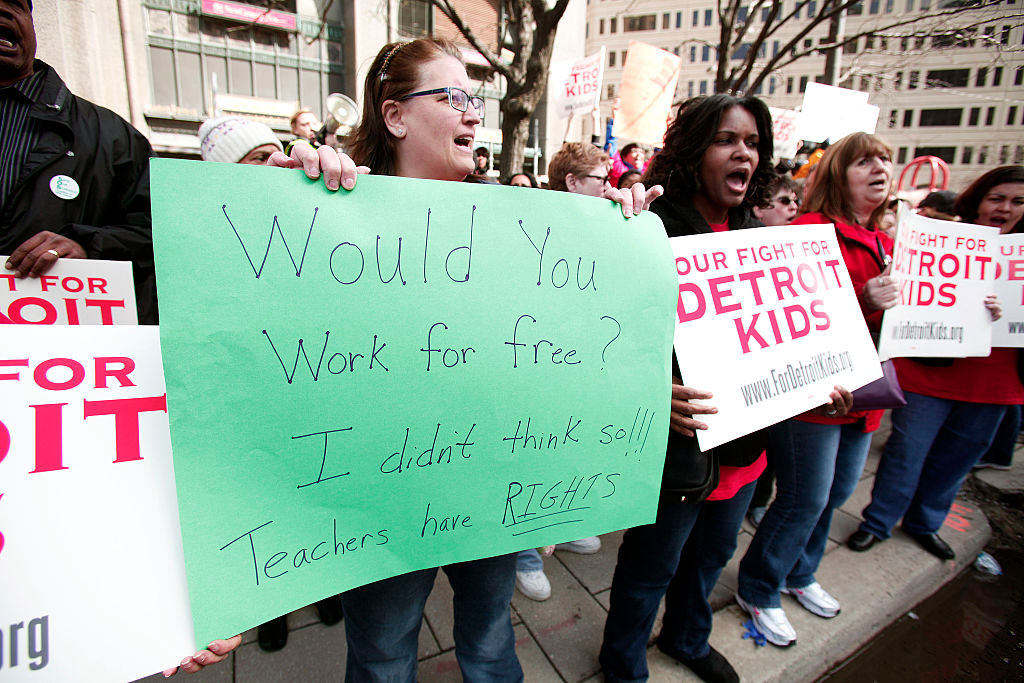
Detroit teachers stage a sick-out for the second day in a row and protest in front of Detroit Public Schools headquarters, causing 94 of the 97 Detroit school districts to close, May 3, 2016 in Detroit, Michigan. (Bill Pugliano / Getty Images)
Few questions are as burning for radicals as how to revive the labor movement. The rising socialist movement will have a very tough time carrying out many aspects of a broad, progressive agenda without US unions rebuilding their membership, going on strike in numbers far greater than they are currently, and fighting for demands that benefit not just union members in one industry but the entire working class.
The recent teachers’ strike wave, seemingly emerging out of nowhere, should give us cause for much hope — not just because it represents a potential rebirth of labor militancy in the United States, but because those strikes give us a road map of how radicals can play key roles in that revitalization. To do so, we can’t just support strikes from outside: we have to embed ourselves as workers on shop floors around the country, joining other workers who aren’t radicals but are workplace leaders in cohering a militant rank-and-file current. Figuring out how to do this recently became even more pressing as the Democratic Socialists of America (DSA), the most important socialist organization in the country, passed a resolution adopting the “rank-and-file strategy” for labor work at its convention in Atlanta.
Eric Blanc has covered the teachers strikes closer than any writer in America. He wrote a book about them, published by Verso as part of the Jacobin series: Red State Revolt: The Teachers’ Strike Wave and Working-Class Politics. Blanc spoke with Jacobin managing editor Micah Uetricht for our podcast, The Vast Majority, about the book. Blanc and Uetricht spoke over two episodes; you can read part one here, and listen to part one here and part two (on which this interview is based) here. The conversation has been edited for length and clarity.