“We Work, We Sweat, Put $15 on Our Check!”
After years of Democratic prevaricating, the House has passed a $15 minimum wage bill. It’s almost certain to die in the Senate — but it shows how far the Fight for $15 movement has come.
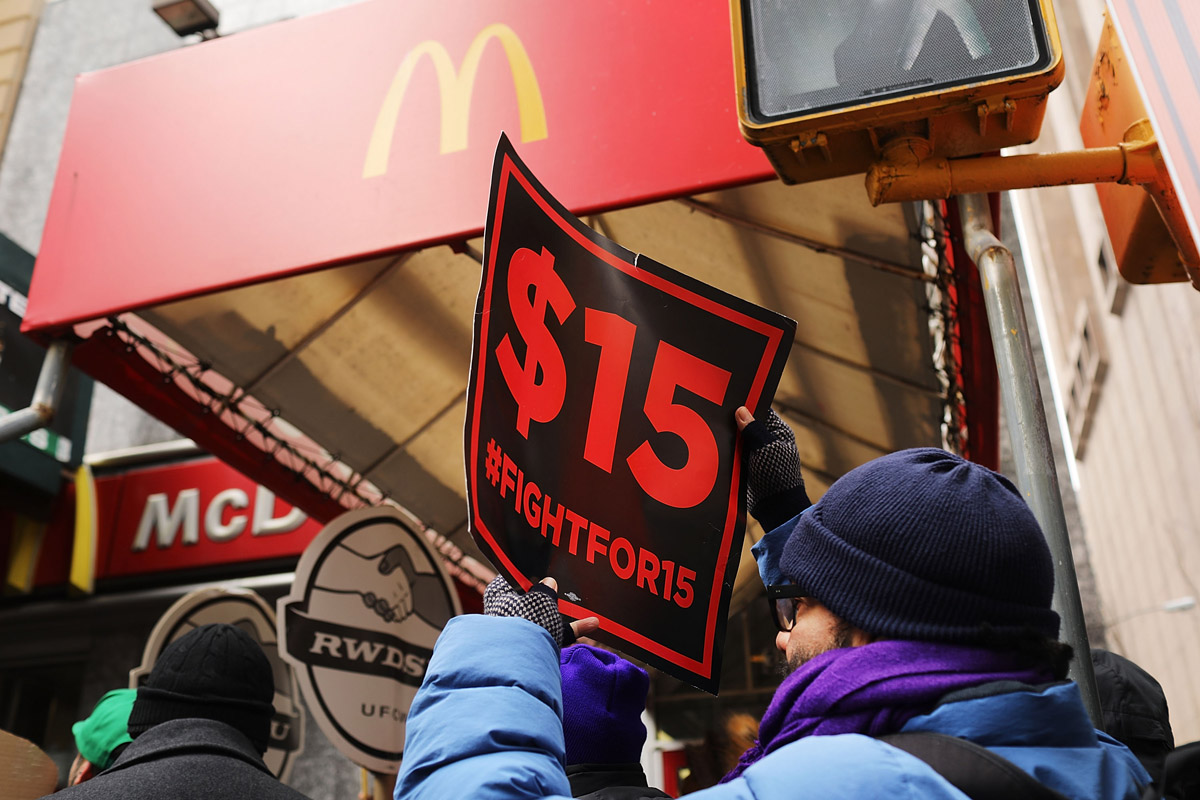
Protesters with Fight for $15 gather in front of a McDonalds to rally against fast food executive Andrew Puzder on February 13, 2017 in New York City. (Spencer Platt / Getty Images)
In November 2012, two hundred workers at Wendy’s, McDonald’s, Burger King, and other restaurants walked off the job in New York City demanding a $15 an hour minimum wage.
It was at that time “the biggest wave of job actions in the history of America’s fast-food industry.” The demand struck many onlookers as a stretch — it was more than double the federal minimum wage of $7.25 an hour. But workers and organizers were undaunted by the skepticism. At that first protest, between chants of “How can we survive on seven twenty-five,” KFC worker Pamela Waldron told the New York Times, “I have two kids under six, and I don’t earn enough to buy food for them.” Fifteen dollars was necessary, workers insisted, for a dignified and secure existence.
The movement born out of these early actions was called Fight for $15, spearheaded primarily by the Service Employees International Union (SEIU). In 2013, fast-food workers organized under this banner walked out in Chicago, Detroit, St. Louis, Milwaukee, Seattle, Flint, and Kansas City. Over the next few years, the movement expanded beyond fast-food to include other low-wage workers all over the country, including airport employees, caregivers, and workers at Walmart and Amazon.